Insurance Office Cleaning: Trusted & Compliant Service
Insurance office cleaning is a professional cleaning service calibrated to the operational, confidentiality, and compliance demands of insurance firms, brokerage offices, underwriting practices, and financial services workplaces. Cost starts from $45 per hour for standard administrative suites, rising to $55 per hour for CBD-based insurers and multi-floor corporate premises with after-hours access requirements. The distinguishing factors in an insurance office environment are the volume of sensitive client documentation in daily circulation, the high standard of client-facing presentation required in consultation and claims rooms, and the Privacy Act 1988 (Cth) obligations that apply to every piece of personally identifiable information visible in the workspace.
Insurance Offices Carry Cleaning Obligations That Generic Commercial Services Miss
Insurance firms regulated by APRA (Australian Prudential Regulation Authority) and holders of an Australian Financial Services Licence (AFSL) under ASIC (Australian Securities and Investments Commission) operate in a scrutinised environment where operational standards - including physical workspace maintenance - reflect directly on regulatory standing and client trust. A cleaning company without documented protocols for handling sensitive financial documents, client files, and claims records creates a compliance exposure that most insurance office managers do not anticipate until it happens.
Document density and circulation volume are structurally different in an insurance workplace. Claims assessors, underwriters, and brokers work daily with policy schedules, personal financial statements, medical reports submitted with claims, and correspondence containing clients' Tax File Numbers, addresses, and health information. Under the Privacy Act 1988 (Cth), insurance firms have a statutory obligation to protect this information from unauthorised access or disclosure. A cleaner who repositions, photographs, or inadvertently discards an open document creates a notifiable data breach under the Notifiable Data Breaches (NDB) scheme administered by the Office of the Australian Information Commissioner (OAIC). This is not a theoretical risk - it is a documented event type that insurance firms must have protocols to prevent.
Client-facing spaces carry reputational weight proportional to the premiums being discussed. An insurance client walking into a consultation room to discuss a complex commercial policy or a life insurance restructure draws an immediate inference from the cleanliness and presentation of the space. Grimy upholstery, fingerprint-smeared glass, or a bathroom that hasn't been serviced that day does not just create an aesthetic problem - it creates a credibility gap at the moment the firm is asking a client to trust it with their financial protection. The Insurance Act 1973 (Cth) places obligations on insurers to deal with clients honestly and fairly; the physical environment in which those conversations occur should reflect the same standard.
WHS Act 2011 (NSW) obligations apply to every insurance office in New South Wales. Under this Act, the person conducting a business or undertaking (PCBU) must ensure the work environment is safe and without risk to health. For a large insurer operating a 500-sqm claims floor with 30 staff, this means documented cleaning schedules, structured waste management, and evidence of regular hygiene maintenance available for SafeWork NSW review if required.
What Insurance Office Cleaning Covers
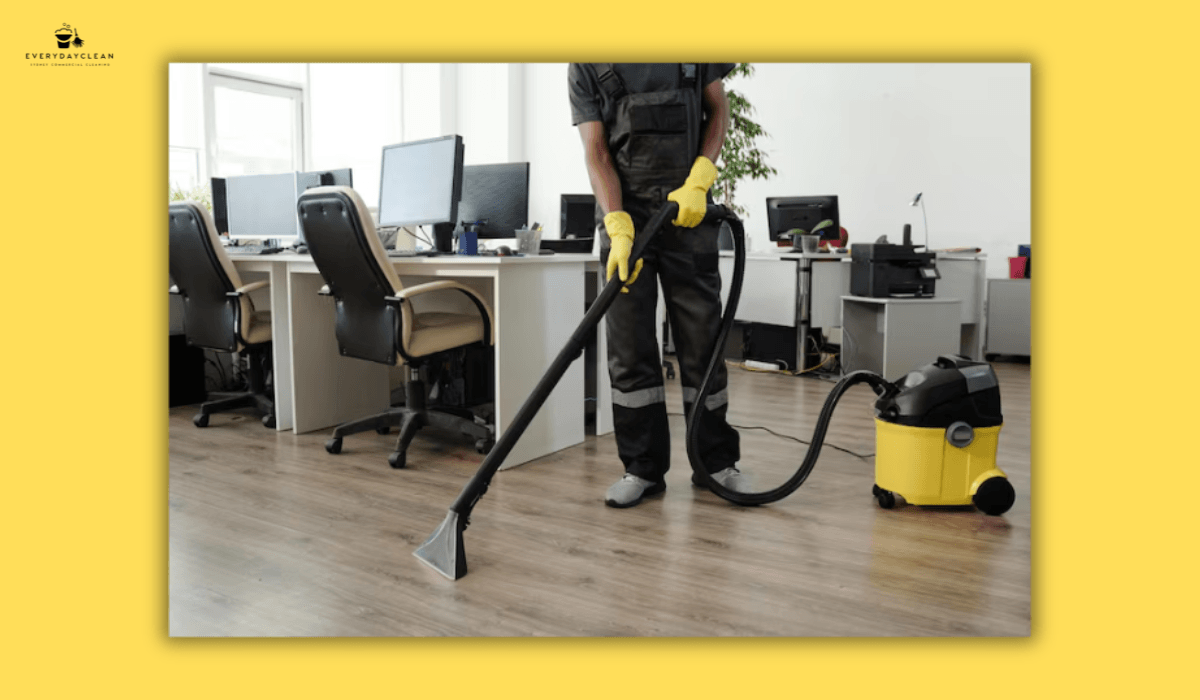
A correctly scoped insurance office clean is structured around five functional zones, each with distinct hygiene priorities.
Client Consultation and Meeting Room Cleaning
Consultation rooms - used for policy reviews, claims discussions, and financial planning sessions - are the highest-priority area in an insurance office from a presentation standpoint. Upholstered seating, table surfaces, electronic presentation equipment, and whiteboard surfaces are cleaned and disinfected at every scheduled visit. TGA-listed disinfectants are applied to all high-touch surfaces: door handles, light switches, shared pens, and digital signing pads. Glass partitions and windows are wiped to a streak-free standard because they form the visual frame clients see as they approach the consultation space.
The clean-around-in-place protocol applies strictly in consultation rooms. Any client document, policy schedule, or claims file left on the table is reported to the practice manager but not touched, moved, or photographed. Whiteboards are cleared only when an explicit written instruction from the office manager is visible.
Workstation, Claims, and Underwriting Area Cleaning
Insurance workstations typically carry dual monitors, a keyboard, a headset, a telephone, and multiple paper-based files at any given time. Surface cleaning uses anti-static microfibre cloths on desk surfaces and dry anti-static wipes on electronics - not spray-and-wipe methods that risk moisture contact with hardware or printed documents. Keyboards are treated with compressed air or dedicated key-safe wipes.
Files and claim documents on desks are left exactly as positioned. The clean-around-in-place rule is the standard, not an optional service level. Insurance firms operating under an AFSL have data handling obligations that extend to every person who accesses their premises, including cleaning staff.
Reception and Client Entry Area Maintenance
The reception area of an insurance office typically processes both walk-in clients and scheduled appointments. It accumulates foot traffic and surface contact at a rate higher than the internal office areas. Reception desk counters, waiting chairs, entry glass, and floor surfaces are cleaned to presentation standard at every visit. High-touch disinfection using TGA-listed surface disinfectants covers door handles, lift buttons, and any touch-screen sign-in systems.
Magazines and printed materials in waiting areas are part of the impression. Tidying these into an orderly display without discarding or reordering any client-facing branded material is a standard task.
Kitchen, Staff Amenity, and Break Room Cleaning
Insurance offices with 10 or more staff generate meaningful kitchen contamination throughout a working day: bench surfaces, appliances, sink surrounds, and shared equipment. These areas are cleaned at every scheduled visit - bench wipedown, appliance exterior cleaning, bin removal, and floor mopping. Refrigerator cleaning is scheduled as a periodic task aligned to the cleaning contract. The bin is emptied using a no-touch liner replacement process to prevent cross-contamination with document waste.
Bathroom Sanitation
Bathrooms accessible to both staff and visiting clients require a service standard that is visibly maintained throughout the day when client volume is high. Toilet, basin, mirror, tap fittings, floor, and paper product restocking are completed at each scheduled clean. Odour is actively controlled - a neutral, professionally maintained bathroom is the minimum standard for a financial services environment receiving clients.
Recommended Cleaning Frequency for Insurance Offices
| Office Profile | Session/Client Volume | Recommended Frequency | Estimated Monthly Cost (2026) |
|---|---|---|---|
| Solo broker or small practice (under 60 sqm) | 5-15 clients/week | 2-3x per week | $300 - $550 |
| Mid-size brokerage, 5-15 staff (60-200 sqm) | 20-50 clients/week | Daily or 5x per week | $900 - $1,800 |
| Insurance firm, 15-50 staff (200-500 sqm) | High-volume, mixed walk-in and booked | Daily | $2,000 - $4,500 |
| Quarterly deep clean (any size) | - | Every 3 months | $300 - $800 per session |
Note: Insurance offices based in central business district high-rise buildings - particularly those on George Street, Pitt Street, or in the Barangaroo financial precinct - typically sit at the upper end of cost estimates. After-hours access coordination, building security sign-in requirements, and Cleaning Services Award 2020 penalty rate loadings for evening work all contribute to higher per-visit costs than suburban insurance practices.
For firms located in the CBD requiring
office cleaning Sydney CBD services, Everyday Clean provides dedicated scheduling, building management coordination, and police-checked staff familiar with after-hours commercial tower access protocols.

Selection Criteria for an Insurance Office Cleaning Provider
Not every commercial cleaning company is configured for the document-handling sensitivity and compliance expectations of a financial services environment. The following criteria are the minimum standard for an insurance office.
- Police-checked staff - All cleaning personnel should hold a current National Police Check (Australian Criminal Intelligence Commission). This is non-negotiable in an environment where staff regularly access client financial and health information.
- Signed NDA or confidentiality agreement - The cleaning provider should have all staff sign a non-disclosure agreement aligned with the firm's Privacy Act 1988 obligations before entering the premises.
- Documented clean-around-in-place protocol - Written policy prohibiting cleaning staff from touching, moving, photographing, or discarding any document, file, or device visible in the workspace.
- Public liability insurance at $10 million minimum - Verify currency of cover before signing any contract. Many insurance firms require $20 million coverage due to the value of client property and documents on site.
- GECA-certified or low-VOC cleaning products - Financial services offices are often enclosed environments with limited ventilation. GECA-certified products and TGA-listed disinfectants with low-VOC formulations protect air quality and comply with NSW Government environmental procurement guidelines.
- Structured quality reporting - A task checklist sign-off after every visit and a supervisor inspection log at agreed intervals is the baseline documentation standard for a professional services cleaning contract.
- Flexible after-hours scheduling - Insurance offices that operate client-facing hours from 8 am to 6 pm cannot accommodate in-hours cleaning disruption. Confirm the provider can clean after-hours with appropriate building access management.
Everyday Clean's office cleaning Sydney service includes police-checked cleaners, NDA-capable staff, GECA-aligned products, and structured quality reporting - the operational requirements for insurance and financial services office cleaning.
Insurance Office Cleaning Pricing in 2026
Three pricing models are standard in the commercial cleaning market in 2026:
- Hourly rate: $45-$55 per hour for CBD and inner-city locations. $38-$48 per hour for suburban insurance offices in the Parramatta, North Sydney, Chatswood, and St Leonards corridors. Rate is inclusive of labour under the Cleaning Services Award 2020, equipment, and standard consumables.
- Monthly flat fee: The preferred contract structure for established insurance offices with predictable operating hours. Built from estimated hours per visit and visit frequency, then fixed as a monthly amount for budget certainty.
- Per-visit rate: Used by smaller brokerages and sole-practitioner advisers operating from sub-50 sqm offices. Practical for lower-frequency arrangements (fortnightly or weekly) where a flat monthly fee overstates actual usage.
For a detailed breakdown of how commercial office cleaning is costed across NSW professional services premises, see the commercial office cleaning cost guide.
Annual contracts delivering 10-20% savings over month-by-month arrangements are standard. A well-drafted commercial cleaning contract specifying task frequencies, document-handling protocols, reporting obligations, and escalation procedures gives insurance firms the documented evidence of diligence that both ASIC conduct requirements and APRA operational risk frameworks expect from regulated entities that outsource operational functions.
FAQs
Insurance office managers, facilities coordinators, and compliance officers at financial services firms ask a consistent set of questions when sourcing professional cleaning. The answers below address the specific concerns that distinguish insurance office cleaning from generic commercial cleaning.
Does Cleaning Staff Need an NDA to Work in an Insurance Office?
Yes, in practice, though the legal mechanism depends on the firm's privacy risk assessment. Under the Privacy Act 1988 (Cth), insurance firms that hold sensitive client information - including health information submitted with claims, financial statements, and personally identifiable data - have an obligation to take reasonable steps to protect that information from unauthorised access or disclosure. A cleaning staff member present in the office while documents are visible constitutes a potential access point. A signed non-disclosure agreement (NDA) between the cleaning contractor and the insurance firm creates a contractual obligation that supplements the firm's internal data governance. Most reputable commercial cleaning companies operating in financial services environments already require staff NDAs as a standard onboarding requirement for these contracts. If the provider cannot supply NDA-signed staff, that is a material disqualification for an AFSL-holding firm.
How Often Should an Insurance Office Be Professionally Cleaned?
Frequency depends on client footfall, staff headcount, and the physical layout of the practice. A small brokerage with five staff and 10-15 client appointments per week is adequately served by two to three professional cleans per week, combined with basic daily staff tidying. A mid-size insurer with 20 staff and a high-volume claims reception requires daily cleaning as a minimum - the bathroom check frequency alone in a walk-in claims environment makes a daily professional service essential. The consultation rooms, which are reset between client meetings throughout the day, may require a targeted mid-day wipe-down of high-touch surfaces in addition to the end-of-day scheduled clean. For practices unsure of the right frequency, an on-site assessment by the cleaning provider - which maps foot traffic, room usage, and surface contamination patterns against a proposed schedule - is the most reliable basis for a correctly scoped contract.
Is Office Cleaning Tax Deductible for Insurance Firms in Australia?
Yes. Professional cleaning of insurance office premises is fully deductible as a business operating expense under the Income Tax Assessment Act 1997 (Cth). The ATO classifies regular cleaning of income-producing premises as an ordinary business outgoing, deductible in the income year the expense is incurred. This applies whether the firm is structured as a company, trust, or partnership. For sole-practitioner brokers operating from a dedicated home office, the deductible portion is calculated proportionally based on the area of the home used exclusively and regularly for business purposes, consistent with ATO home office expense guidance. Retain all invoices and service records for substantiation. For practices operating under a corporate structure with multiple premises, cleaning invoices per site are standard general and administrative expense line items in the profit and loss statement.
What Should an Insurance Office Cleaning Contract Include?
A cleaning contract for an insurance office should go beyond standard scope-of-work and pricing terms. The following elements are essential for a financial services environment: a documented task frequency schedule specifying exactly which areas are cleaned at each visit and at what interval; a confidentiality and document-handling clause that explicitly prohibits cleaning staff from touching, moving, reading, or photographing any document, file, device, or screen visible in the workspace; evidence of staff police checks provided prior to commencement and maintained current throughout the contract term; current certificate of currency for public liability insurance ($10-$20 million depending on the value of property on site); a quality reporting mechanism - at minimum a task sign-off checklist per visit - that creates an auditable record the firm can produce if a WHS audit or privacy incident investigation requires it; and a variation and escalation process covering what happens when cleaning standards fall short of agreed KPIs.
Professional Cleaning as an Operational Risk Control for Insurance Firms
Insurance firms are in the business of assessing and managing risk on behalf of clients. The irony of operating from a poorly maintained, insufficiently cleaned workspace is that it creates the exact category of operational risk - reputational, data security, and WHS compliance risk - that a well-run insurer would price into a policy for someone else. A documented, consistently delivered professional cleaning service is not a facility overhead for an insurance office; it is an operational risk control that protects the firm's licence conditions, client trust, and staff health simultaneously.
Everyday Clean provides specialist office cleaning for insurance firms, brokerage offices, and financial services practices across the greater metropolitan area. With over 20 years of experience, police-checked staff, NDA-capable operations, and GECA-aligned products, the team delivers compliant, document-safe cleaning for professional services offices.
Blog