Government Office Cleaning: Compliant & Secure
Government office cleaning in Sydney operates under a compliance framework that is materially stricter than standard commercial office cleaning. Pricing starts from $45 per hour for general administrative facilities, rising to $55-$65 per hour for secured or high-clearance environments in the CBD. The variables that determine scope and cost include floor area, security classification, cleaning frequency, access restrictions, whether the facility falls under the NSW whole-of-government cleaning contract administered by the Department of Education from January 2026, and whether staff require National Police Checks or AGSVA (Australian Government Security Vetting Agency) clearances before entry.
Government Office Cleaning Demands a Higher Compliance Standard
Government premises - ranging from local council offices and NSW government department buildings to federal administrative centres - require commercial cleaning services that satisfy obligations across three distinct compliance layers: workplace health and safety legislation, security protocols, and public sector procurement rules. A cleaning company that meets general commercial standards but has no documented government facility experience is structurally unsuitable for these contracts, regardless of price.
The Work Health and Safety Act 2011 (NSW) establishes the baseline. All persons conducting a business or undertaking (PCBUs) operating in NSW government buildings must ensure the work environment remains safe and without risk to health. Under WHS Regulation 2017, this includes maintaining a current hazardous chemical register with Safety Data Sheets (SDS) for every cleaning product on site, ensuring GHS-compliant labelling, and providing documented staff training. SafeWork NSW inspectors can request these records during unannounced audits. The consequence of non-compliance is not just a penalty notice - it is removal from a government contract, which carries reputational and contractual consequences that extend beyond the specific site.
Security requirements add a layer that does not exist in the private sector cleaning. Government offices that handle PROTECTED or SECRET-classified information under the Protective Security Policy Framework (PSPF) - administered by Australia's Attorney-General's Department - require cleaning staff to hold AGSVA security clearances at Baseline level minimum. Facilities where SECRET materials are accessed require Negative Vetting Level 1 (NV1) clearance for cleaning personnel. Most standard government administrative offices - Service NSW shopfronts, council chambers, departmental offices - require a NSW Police Check (Australian Criminal Intelligence Commission check) rather than full PSPF clearance, but this must be current and verified before each staff member enters the premises.
Public sector procurement rules govern how contracts are awarded and managed. Under the NSW Procurement Policy Framework, government agencies must procure cleaning services through approved panel arrangements where they exist - including the whole-of-government Cleaning Services Contract now managed by the NSW Department of Education from 1 January 2026. For agencies outside the mandatory panel scope, tenders are published through the NSW eTendering platform and assessed on value for money, demonstrated compliance capability, environmental management, and workforce conditions - not price alone.
What Government Office Cleaning in NSW Actually Covers
Government facility cleaning covers the same physical zones as commercial office cleaning, but with added documentation, reporting, and audit requirements built into every task.
Workstation and Common Area Cleaning
Daily cleaning of workstations, shared desks, and common areas follows the same surface disinfection and vacuuming protocol used in corporate offices, but with one critical difference: government staff are typically required to operate under a clear-desk policy that requires all documents and devices to be secured before cleaners enter. Cleaners are trained to report - not touch or move - any visible document or device that was not secured before the clean. This is not a preference; it is a security protocol aligned with the PSPF's physical security requirements for government information management.
High-touch surfaces, including door handles, light switches, lift buttons, shared keyboard stations, and meeting room equipment, are disinfected using TGA-listed products at every routine visit. In government buildings with high public foot traffic - including Service NSW centres, council offices, and public inquiry counters - the disinfection frequency for these surfaces increases to multiple times daily, consistent with WHS obligations under the model Code of Practice for Managing the Work Environment and Facilities.
Secure Area and Restricted Zone Cleaning
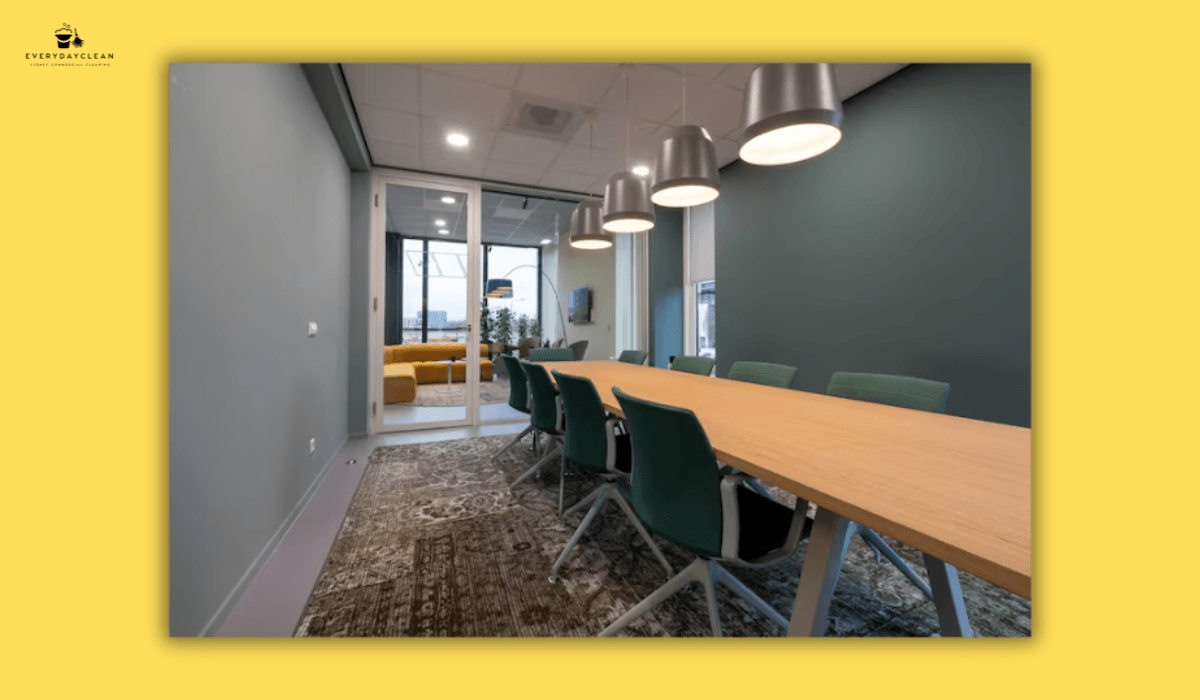
Government buildings frequently contain zones with layered access controls. Server rooms, file archives, executive offices, and areas where classified documents are stored may require cleaners to be escorted by an authorised facility security officer at all times. Cleaning of these zones is scheduled separately from general maintenance - typically on a reduced frequency, with a dedicated scope document that lists permitted tasks and explicitly prohibits photography, document handling, and unsupervised access to storage areas.
Secure document bins, cross-cut shredders, and locked filing units are not emptied or repositioned by cleaning staff. Only the standard waste from general bins is removed, with segregated recycling streams managed in accordance with the facility's waste management plan and relevant council requirements under the Protection of the Environment Operations (POEO) Act 1997 (NSW).
Bathroom, Kitchen, and Public Waiting Area Maintenance
Government buildings with public-facing services - including courts, licensing offices, and community health centres - experience significantly higher bathroom and waiting area usage than closed corporate offices. Sanitation schedules for these spaces are calibrated to foot traffic volume, not a standard daily cycle. High-volume public waiting areas typically require a minimum of two bathroom checks per day, with a documented inspection log maintained on-site and available for review by NSW Public Works or the relevant contract principal.
Kitchen and staff amenity cleaning covers bench surfaces, sink, appliances, refrigerator exterior, and bin removal. GECA-certified cleaning products are preferred across government facility contracts because they align with NSW Government environmental procurement guidelines and reduce VOC exposure in enclosed, often poorly ventilated internal spaces.
Security Clearance and Vetting Requirements for Government Cleaners
Security clearance requirements represent the most significant operational difference between government and standard commercial cleaning.
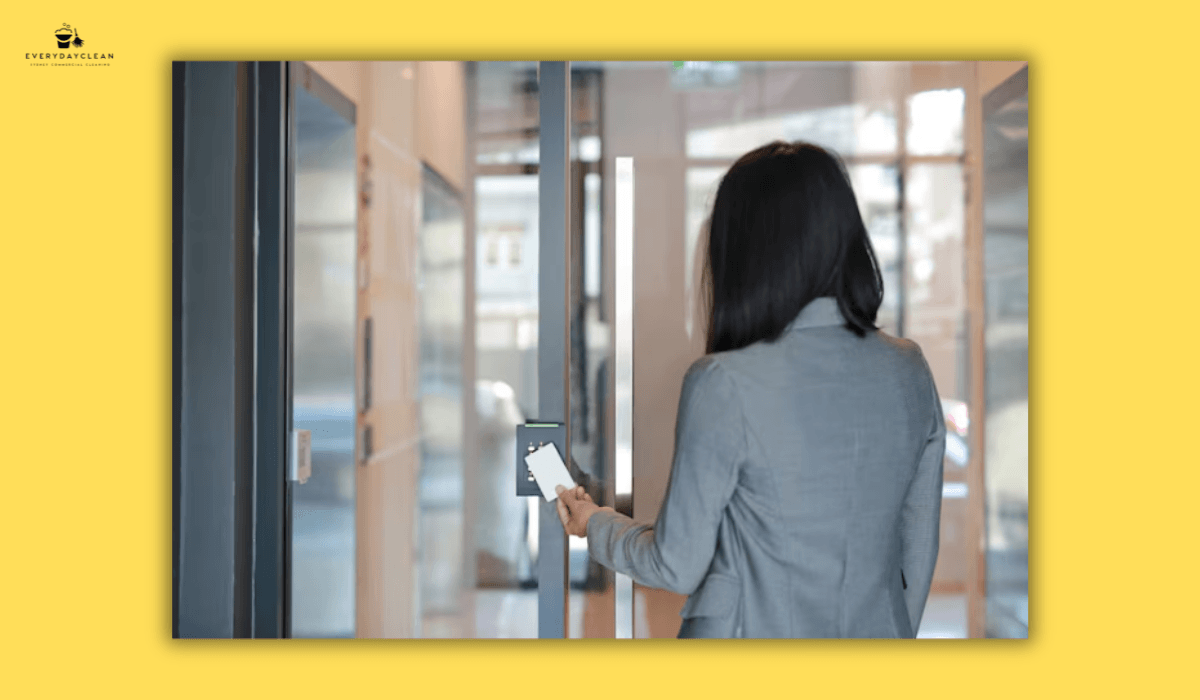
For the majority of NSW state government administrative offices, a current National Police Check through the Australian Criminal Intelligence Commission (ACIC) is the baseline requirement for all cleaning staff. Many contracts also require a signed confidentiality agreement and a site-specific induction covering access procedures, clear-desk compliance, and emergency evacuation protocols.
For federal government facilities in Sydney - including ATO offices, Services Australia centres, and Department of Home Affairs premises - requirements escalate. The PSPF mandates that cleaning staff's access to areas where PROTECTED information is stored requires Baseline clearance. AGSVA processing timelines for Baseline clearance typically run four to eight weeks, meaning workforce planning for government contracts must account for this lead time. Cleaning companies bidding on federal contracts without a vetted workforce already in place cannot realistically commence within a standard contract mobilisation window.
For facilities handling SECRET or TOP SECRET materials - rare in standard administrative environments but relevant for Defence-related agencies in greater NSW - NV1 and NV2 clearances apply respectively. These clearance levels require financial background checks, referee interviews, and extended processing periods of three to six months.
Pricing for Government Office Cleaning in 2026
Government facility cleaning is typically priced at a premium to standard commercial office cleaning, reflecting the additional compliance overhead, documentation requirements, security vetting costs, and the expectation of regular quality audits.
| Facility Type | Recommended Frequency | Estimated Monthly Cost (2026) |
|---|---|---|
| General admin office, state government (under 300 sqm) | 3-5x per week | $800 - $1,800 |
| Public-facing service centre (300-600 sqm) | Daily + mid-day check | $2,000 - $4,000 |
| Multi-floor government building (600-2,000 sqm) | Daily | $4,000 - $9,000 |
| Post-public-event deep clean (any size) | As required | $500 - $2,000 per event |
Note: For office cleaning Sydney CBD government locations - particularly high-rise buildings on Phillip Street, Macquarie Street, or in the Parramatta CBD government precinct - pricing sits at the upper end of each range. After-hours access coordination with building management, security sign-in requirements, and penalty rate loadings under the Cleaning Services Award 2020 all contribute to a higher base cost than suburban government facilities.
Public liability insurance minimums for government cleaning contracts in NSW sit at $20 million - double the $10 million floor required for standard commercial work. Workers' compensation through Icare (under the Workers Compensation Act 1987 (NSW)) is mandatory, and contractors must provide current certificates of currency to the contract principal before each renewal period.
For a detailed breakdown of how office cleaning costs are structured across different NSW facility types, see the
commercial office cleaning cost guide.
What a Government Facility Cleaning Provider Must Demonstrate
Not every commercial cleaning company can satisfy the documentation and operational requirements of a government cleaning contract. The following criteria separate qualified providers from standard commercial operators.
- Police-checked workforce - Every cleaner must hold a current National Police Check. For federal contracts, AGSVA clearance documentation must be provided and maintained current, with revalidation tracked by the contractor.
- WHS compliance system - A documented WHS management plan, current SDS register for all chemicals used, GHS-compliant labelling, and evidence of regular staff WHS training aligned with SafeWork NSW requirements.
- Quality management and reporting - Government contracts typically require a 12-week quality management inspection cycle, documented in a site-specific cleaning manual. The NSW whole-of-government contract uses the WebClean platform to allow agency staff to monitor cleaning activity, log complaints, and track contractor KPIs in real time.
- Public liability insurance at $20 million minimum - Verify the currency of the policy before signing. Government contracts that have underinsured cleaning providers expose the agency to unrecovered loss in a public liability event.
- GECA-certified or equivalent cleaning products - NSW Government environmental procurement guidelines preference low-VOC, biodegradable products. GECA certification provides the documented third-party verification most procurement officers require.
- Flexible scheduling compatible with building security - Government facilities typically restrict after-hours access to vetted personnel only. Confirm the cleaning provider has operational experience navigating NSW government building security management protocols, including alarm systems, CCTV monitoring, and swipe card access procedures.
Everyday Clean's office cleaning Sydney service includes police-checked cleaners, WHS-compliant operations, GECA-aligned products, and documented quality reporting - the core requirements for government and public sector facility cleaning across the greater metropolitan area.
Pricing and Contract Structures for Government Cleaning
Government cleaning contracts in NSW follow one of three procurement pathways. Agencies covered by the mandatory whole-of-government Cleaning Services Contract (now managed by the NSW Department of Education from January 2026) must use approved panel contractors. For agencies outside this scope, open tender via NSW eTendering is the standard mechanism. Smaller agencies and local councils may approach the market through a Request for Quote (RFQ) process for contracts under the relevant procurement threshold.
Regardless of procurement pathway, the pricing structure follows one of the established commercial models: hourly rate ($45-$65/hour for CBD and inner-city locations), monthly flat fee calculated from estimated hours and frequency, or per-square-metre rates ($3.50-$8.50/sqm for standard office environments).
Annual contracts typically deliver 10-20% cost savings over month-by-month arrangements. A clearly structured commercial cleaning contract specifying task frequencies, reporting obligations, KPIs, penalty provisions, and escalation processes is essential in government facility cleaning - both to protect the agency and to give the cleaning provider unambiguous scope guidance.

FAQs
Government facility managers and procurement officers routinely ask the same questions when assessing cleaning providers for public sector sites. The answers below address the specific compliance and operational concerns that distinguish government from standard commercial cleaning.
Does Government Office Cleaning in NSW Require Police Checks for All Staff?
Yes, for virtually all government premises in NSW. The NSW Public Works whole-of-government Cleaning Services Contract explicitly requires all cleaning staff to hold a current NSW Police security clearance check, and a valid Working with Children Check where children may be present at the site. This requirement applies to all staff who attend the site, not only supervisors or lead cleaners. The cleaning contractor is responsible for obtaining, documenting, and maintaining the currency of all clearance records. NSW Public Works quality assurance inspectors verify compliance with this requirement during random and complaint-triggered site audits. For federal government facilities in greater NSW, the AGSVA Baseline clearance requirement applies rather than the NSW Police Check, and the processing timeline must be factored into contract mobilisation planning.
Does the NSW Whole-of-Government Cleaning Contract Apply to All Government Agencies?
It applies as a mandatory arrangement for agencies covered by its scope, which has historically included government offices, schools, TAFE colleges, and other NSW public assets managed through NSW Public Works. From 1 January 2026, the Department of Education assumed management of the contract from NSW Public Works. Agencies enquiring about their coverage status should contact cleaningservices@det.nsw.edu.au. Local councils and statutory authorities are not automatically bound by the contract and may procure cleaning services independently through the NSW eTendering platform, consistent with the NSW Procurement Policy Framework. Federal government agencies in NSW procure through AusTender rather than NSW eTendering and are subject to Commonwealth Procurement Rules rather than state procurement policy.
Can Government Cleaning Be Conducted During Business Hours?
Yes, though the practical implications vary significantly between facility types. Many government administrative offices prefer after-hours cleaning to avoid disruption to staff operations and to ensure compliance with clear-desk security protocols - cleaners can work through all areas without staff present and without the security risk of documents left visible during cleaning. Public-facing service centres, however, often require mid-day bathroom checks and waiting area maintenance during business hours because foot traffic volume demands it. After-hours cleaning in NSW government buildings, attracting Cleaning Services Award 2020 evening penalty rates (15% loading for 6 pm-midnight, Monday-Friday) is typically absorbed into the monthly flat fee rather than itemised as a surcharge, provided the schedule is set at contract commencement. Changes to agreed cleaning times during the contract term may trigger a variation and cost adjustment.
What Insurance Is Required for Government Cleaning Contracts in NSW?
Public liability insurance at $20 million minimum coverage is the standard requirement for NSW government cleaning contracts - double the $10 million floor required for standard commercial work. Workers compensation through icare (under the Workers Compensation Act 1987 (NSW)) is mandatory, and the contractor must provide a current Certificate of Currency to the agency before work commences and at each annual renewal. Some government contracts also require professional indemnity insurance, particularly where the cleaning scope includes specialised services such as hazardous waste management, biohazard decontamination, or post-flood remediation. Product liability coverage is prudent where the cleaning contractor supplies specialised chemicals that differ from the agency's standard procurement. All certificates should be verified for currency - not merely sighted - before any contract is awarded or renewed.
Government Office Cleaning as a Compliance Investment, Not an Overhead
Government offices are public spaces. The standard of hygiene, safety, and presentation maintained in these buildings is a direct reflection of how a department or agency manages its operational obligations - and that standard is observed by both the public and by SafeWork NSW. A cleaning service that does not understand the WHS Act 2011 (NSW), cannot demonstrate a vetted workforce, and lacks documented quality reporting systems creates a compliance liability, not a cost saving.
Everyday Clean provides professional commercial cleaning for government offices, public sector facilities, and administrative buildings across the greater metropolitan area. With over 20 years of experience, police-checked staff, WHS-aligned operations, and GECA-certified products, the team is equipped to meet the documented compliance requirements of NSW government cleaning contracts.
Blog