Business Coaching Office Cleaning: Session-Ready Workspaces
Business coaching office cleaning in Sydney starts from $45 per hour for standard session-room maintenance, rising to $55 per hour for CBD locations with after-hours access requirements. Frequency, session turnover volume, client-facing presentation standards, and whether the practice operates from a dedicated studio or a shared commercial building all determine the final cost and cleaning scope. Coaching offices differ from conventional corporate workplaces in one defining way: every client who enters the space is already in a heightened state of self-evaluation, making the psychological environment - including its cleanliness - a direct input to the coaching outcome.
Business Coaching Offices Have Distinct Cleaning Requirements
A generic commercial clean designed for open-plan offices does not map well onto a business coaching practice. The physical and psychological demands are different at three levels.
Session rooms operate as high-touch, high-reset environments. A business coach running five client sessions per day rotates through a single room repeatedly, with each client touching the same chair, table, whiteboard, pen holder, and door handle. The surface contamination between sessions in this format is comparable to a medical waiting room - not because of infection risk, but because of the volume of hand and surface contact compressed into a small area. A cleaning protocol built for an end-of-day single clean is structurally inadequate for this pattern. Between-session wipe-downs of high-contact surfaces, combined with an end-of-day deep clean, is the standard that a properly configured coaching practice cleaning service delivers.
The physical environment carries psychological weight in a coaching context. Business coaching - whether delivered under ICF (International Coaching Federation) accreditation, through NLP (Neuro-Linguistic Programming) frameworks, or as executive leadership development - depends on the client feeling psychologically safe, open to vulnerability, and focused. Research published in the Journal of Environmental Psychology demonstrates that visual disorder (visible clutter, stained upholstery, marked surfaces) triggers the brain's threat-detection system, which directly competes with the open cognitive state coaching requires. A dusty credenza or fingerprint-marked glass panel is not just an aesthetic problem in a coaching office - it is a functional one.
Client confidentiality extends to the physical space. Notes left on whiteboards, printed frameworks visible on desks, or named materials from one session must not carry over to the next client. The clean-around-in-place discipline developed for legal and financial office environments applies equally here. Cleaners should not erase, photograph, reposition, or discard any written materials without explicit instruction from the practice owner.
What a Business Coaching Office Cleaning Service Covers
A correctly scoped business coaching office clean addresses five distinct zones, each with different priorities.
Session Room Cleaning and Reset
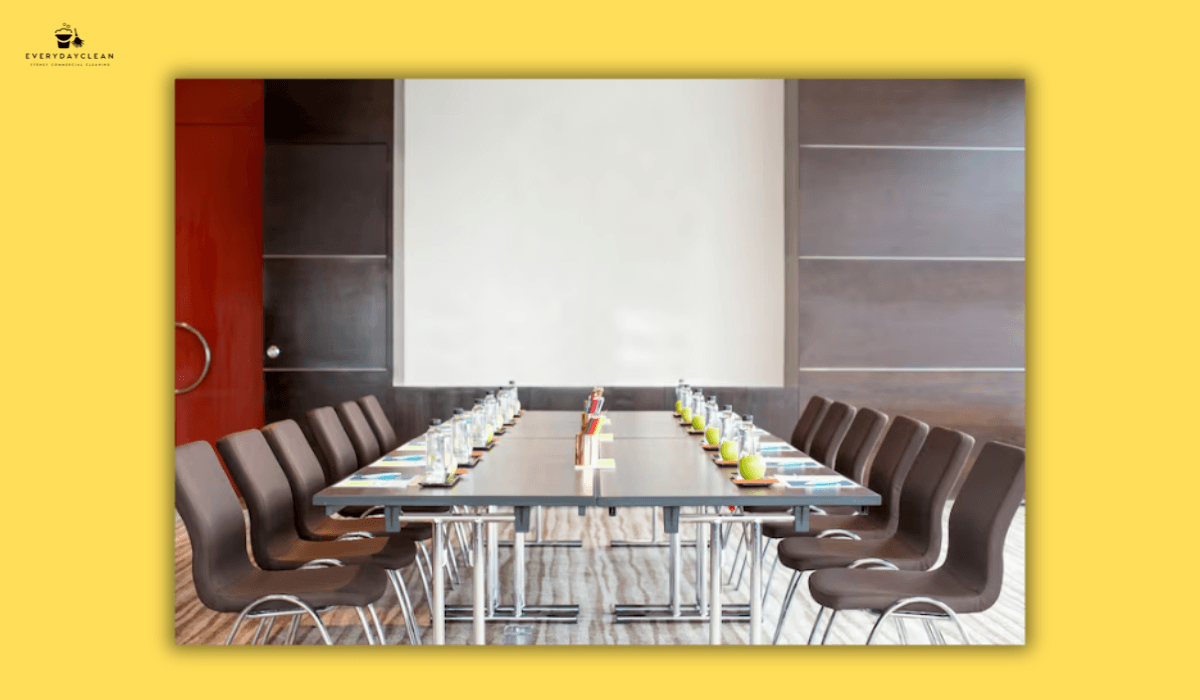
The coaching session room - typically furnished with two to four chairs, a low table, a whiteboard, and a side unit - requires the most frequent attention. Upholstered chairs accumulate body oils and particulates faster than hard surfaces and should be wiped with an appropriate fabric-safe sanitiser at every scheduled clean. The whiteboard must be fully cleared and cleaned using a proper whiteboard cleaner - not a general multipurpose spray, which leaves a residue layer that gradually reduces the whiteboard's write-erase response and traps ghost images of previous sessions. Tables, armrests, and door handles are high-contact surfaces that require proper disinfection of high-touch surfaces using a TGA-listed disinfectant at each visit.
Floors in session rooms are vacuumed using HEPA-filter equipment and spot-mopped. Coaching rooms that use natural fibre rugs for acoustic softening require appropriate suction settings to prevent fibre damage - aggressive extraction on low-pile rugs is a common error by general cleaning crews unfamiliar with professional services environments.
Reception and Client Arrival Area Cleaning
The reception or client arrival area is the first physical impression a coaching client forms of the practice. In business coaching, where the practitioner's professional credibility is the primary product, this space must project the same standard of calm, ordered competence the coach projects in person. Seating, side tables, flooring, entry glass, and any branded display materials are cleaned to presentation standard at every visit. High-touch surfaces, including door handles, light switches, and reception desk counters, are disinfected using TGA-listed disinfectants.
Odour control in the waiting area matters. Coaches operating in CBD premises often share building ventilation, which can introduce food or industrial odour from other tenants. A properly cleaned reception area eliminates residual scent from previous sessions and creates a neutral, professionally maintained environment.
Whiteboard and Visual Facilitation Equipment
Business coaches frequently use floor-to-ceiling whiteboard walls, glass walls with marker surfaces, or moveable whiteboard panels for group workshops and strategy sessions. These surfaces require dedicated maintenance beyond the session room wipe-down. Ghost imaging - the shadow of previous markings visible through new content - is the most common complaint in coaching practices with heavy whiteboard use. It results from dry-erase markers left on the surface too long, combined with inadequate whiteboard cleaner use.
A professional cleaning service managing a coaching office should include periodic deep whiteboard restoration using an appropriate whiteboard conditioner, applied at monthly or quarterly intervals depending on usage frequency. This is not a standard task in a generic commercial clean - it requires specific product knowledge and a different motion technique from standard wiping.
Kitchen and Refreshment Area Maintenance
Most coaching practices offer tea, coffee, or water to clients as part of the session ritual. The kitchen or refreshment station - even a simple bench with a kettle and cups - requires daily cleaning. Bench surfaces, the kettle exterior, cup storage area, and any shared appliances are wiped and sanitised. The bin is emptied to prevent odour carry-over into the session room. In practices with a full kitchen, the standard scope covers benches, sink, microwave, refrigerator exterior, and floor.
Bathroom Sanitation
In a coaching practice receiving multiple clients daily, the client bathroom functions as an extension of the first impression. Toilet, basin, mirror, tap fittings, floor, and paper product restocking are completed at each cleaning. Odour is actively managed - a bathroom that smells of cleaning product is preferable to one that smells of previous use, but a neutral, fresh environment is the professional standard.
Recommended Cleaning Frequency for Business Coaching Offices
Frequency is determined by session volume and client-facing expectations:
| Practice Profile | Session Volume | Recommended Frequency | Estimated Monthly Cost (2026) |
|---|---|---|---|
| Solo coach, 1-2 session rooms (under 60 sqm) | 3-5 sessions/day | 3x per week | $350 - $600 |
| Small practice, 2-4 coaches (60-150 sqm) | 8-15 sessions/day | Daily or 5x per week | $900 - $1,600 |
| Group workshop facility (150-300 sqm) | Mixed: 1:1 + workshops | Daily + post-workshop deep clean | $1,500 - $2,500 |
| Quarterly deep clean (any size) | - | Every 3 months | $300 - $700 per session |
Note: Coaching offices in major commercial buildings - particularly those near Martin Place, Barangaroo, or the Clarence Street business corridor - typically sit at the upper end of these estimates. Building access coordination, security protocols, and Cleaning Services Award 2020 after-hours penalty rates all contribute to higher per-visit costs at those locations.
For office cleaning Sydney CBD locations specifically, building management requirements around sign-in procedures, key access, and lift booking for after-hours cleaning add 15-25 minutes of non-cleaning time to each visit, which is reflected in most professional cleaning quotes for CBD coaching practices.
Key Selection Criteria for a Business Coaching Office Cleaning Provider
Not all commercial cleaning companies are configured for the operational and relational demands of a coaching environment. The following criteria separate a capable provider from a generic one.
- Police-checked staff - Cleaners entering a coaching practice are present in a space used for confidential conversations. A current National Police Check is the baseline standard for any provider working in a client-facing professional services environment.
- Written clean-around-in-place protocol - The provider should have a documented policy preventing staff from touching, moving, photographing, or discarding any written materials, printed frameworks, or notes visible in session rooms.
- Whiteboard-specific cleaning competency - Ask providers explicitly whether their staff are trained in whiteboard maintenance and whether they carry whiteboard cleaner (not multipurpose spray) as standard equipment. This is a reliable indicator of experience with professional services environments.
- GECA-certified or low-VOC cleaning products - Coaching sessions rely on air quality as part of the physical environment. GECA-certified products and TGA-listed disinfectants with low-VOC formulations protect air quality and prevent chemical odour carry-over between sessions.
- Flexible scheduling aligned to session timetables - The cleaning schedule should account for the practice's session timing. A coach running evening sessions cannot accommodate a 5 pm clean. Providers should offer morning pre-session cleans, after-hours end-of-day cleans, or both.
- Public liability insurance - Minimum $10 million cover is standard in NSW for commercial cleaning contracts.
Everyday Clean's office cleaning Sydney service includes police-checked cleaners, GECA-aligned products, and flexible scheduling built around the operational rhythms of professional services offices across the greater metropolitan area.
Business Coaching Office Cleaning Pricing in 2026
Three pricing models are standard across the commercial cleaning market in 2026:
- Hourly rate: $45-$55 per hour for CBD and inner-city locations. $38-$48 per hour for suburban practices in areas such as Chatswood, Parramatta, St Leonards, and the Inner West. This rate is inclusive of labour under the Cleaning Services Award 2020, equipment, and standard consumables.
- Monthly flat fee: The preferred model for ongoing coaching practice contracts. Built from estimated hours per visit multiplied by visit frequency, then fixed as a monthly amount. Removes invoice variability for the practice owner and allows the cleaning provider to staff and plan efficiently.
- Per-session reset fee: Used in high-volume day coaching programs or workshop facilities where a short between-session refresh is required mid-day. Typically priced at $25-$60 per reset, depending on room count and scope.
For a complete breakdown of pricing variables applicable to professional services offices in NSW, see the commercial office cleaning cost guide.
A 12-month
commercial cleaning contract typically delivers 10-20% cost savings compared to month-by-month arrangements, and provides the documentation and scope certainty that most coaching practice operators prefer when managing a fixed operational budget.

FAQs
Business coaches and practice managers ask a consistent set of questions when sourcing professional cleaning for their offices. The answers below address the most operationally relevant concerns, grounded in the specific environment of a coaching practice rather than generic office cleaning.
How Does Office Cleanliness Affect Client Experience in a Coaching Practice?
The psychological mechanism is well-established. A 2021 ISSA survey found that 92% of consumers reported a dirty or disorganised workplace would reduce their confidence in that business's services. In a coaching context, the stakes are higher: a client entering a session room in a state of personal or professional vulnerability is acutely sensitive to environmental signals. Visual disorder - marked upholstery, residue on whiteboards, fingerprint-smeared glass, or an odorous bathroom - triggers subconscious threat-detection that actively competes with the psychological openness coaching requires. Cleanliness in a coaching practice is not a peripheral operational concern - it is a direct component of the service quality the client is paying for.
Can Office Cleaning Be Scheduled Around Coaching Session Timetables?
Yes, and this is standard practice for coaching offices that operate from 7 am to 7 pm or later. Most professional cleaning companies offer two scheduling options: a morning pre-session clean (typically 6:00-7:30 am) that prepares rooms before the first client arrives, and an after-hours end-of-day clean (7:30-9:00 pm) performed after the final session. Some high-volume practices use both - a quick morning refresh and a thorough end-of-day deep clean. The key logistical requirement is that the cleaning provider can coordinate with the building manager for after-hours key or swipe card access, and that cleaners are briefed on alarm arming procedures. In NSW commercial buildings, this is standard operational capability for established cleaning companies. After-hours cleaning attracts a penalty rate loading under the Cleaning Services Award 2020, which is typically embedded in the monthly flat fee rather than itemised as a surcharge.
How Should Whiteboard Content Be Handled During a Clean?
The correct protocol is no-touch and no-erase unless explicitly authorised in writing by the practice owner. Whiteboards in session rooms often contain client-specific frameworks, strategy maps, or personal development content that belongs to the coaching relationship, not the cleaning service. A cleaning provider working in a coaching office should have a documented clean-around protocol covering: no erasure of any whiteboard content without written sign-off, no photographing of written content, and no repositioning of printed or handwritten materials. When end-of-day whiteboard clearing is required, it should be listed as an explicit task in the cleaning scope with an agreed trigger - such as the coach leaving a visible note - rather than assumed as a default action. This protects the practice's confidentiality obligations and prevents costly session continuity errors.
Is Business Coaching Office Cleaning Tax Deductible in Australia?
Yes. Office cleaning is classified as a business operating expense and is fully deductible under the Income Tax Assessment Act 1997. For a coaching practice operating from dedicated commercial premises, the full cost of professional cleaning services is deductible as an ordinary business outgoing directly related to income-producing activities. For sole-trader coaches operating from a dedicated home office, the deductible portion is calculated proportionally based on the floor area used exclusively for business purposes, consistent with ATO guidance on home-based business expenses. Coaching practices operating as companies or trusts claim commercial cleaning invoices as standard operating expenditure. Retain all invoices and service records for ATO substantiation.
The Coaching Office Environment Is Part of the Service
A business coaching practice is not a back-office operation. It is a client-facing, trust-dependent environment where the physical space reinforces - or quietly undermines - every commitment a coach makes about professionalism, safety, and rigour. A consistently clean practice signals the same attention to detail that clients are paying to develop in their own businesses. The session room, reception area, whiteboard surfaces, and bathroom are not separate operational concerns - they are part of a single impression that either opens or narrows a client's capacity to engage.
Blog