How Long Does Commercial Office Cleaning Take? Factors
A small office of up to 10 desks usually takes 45 minutes to 1.5 hours for a standard clean, a medium office often runs 1.5 to 3 hours, and a large office can need 3 to 6 hours or a team split across zones. Deep cleaning can take two to three times longer than a regular service. The exact duration depends on floor area, the number of bathrooms and kitchen areas, floor type, current condition and how often the space is cleaned.
Time estimates matter because they shape scheduling, after-hours access and how many cleaners are needed on site. The ranges below give a planning guide rather than a fixed promise, since every office layout, condition and scope is different.
Office cleaning time ranges by office size
Office size is the first factor that sets cleaning duration. As a planning guide based on common Australian cleaning scopes, standard maintenance cleaning tends to fall into these ranges:
| Office size | Approx. area | Standard clean | Deep clean |
|---|---|---|---|
| Small (up to ~10 desks) | Up to ~100 sqm | 45 min to 1.5 hrs | 2 to 4 hrs |
| Medium (~10 to 30 desks) | ~100 to 300 sqm | 1.5 to 3 hrs | 4 to 7 hrs |
| Large (~30 to 60 desks) | ~300 to 600 sqm | 3 to 6 hrs | 7 to 12 hrs |
| Multi-floor / open plan | 600 sqm plus | Team-based, split by zone | Full day or multiple visits |
These figures assume a reasonably maintained space cleaned on a regular schedule. A neglected or heavily used office can push well beyond the upper end. For a detailed breakdown of what a full clean includes, an office cleaning checklist helps match tasks to time.
How is cleaning time affected by desk count versus floor area?
Both matter, but they measure different things. Desk count reflects how many touchpoints, bins and personal work areas need attention, while floor area reflects the vacuuming, mopping and general surface work. A dense open-plan office with many desks in a small footprint can take longer per square metre than a spacious layout with fewer people.
Regular cleaning versus deep cleaning duration
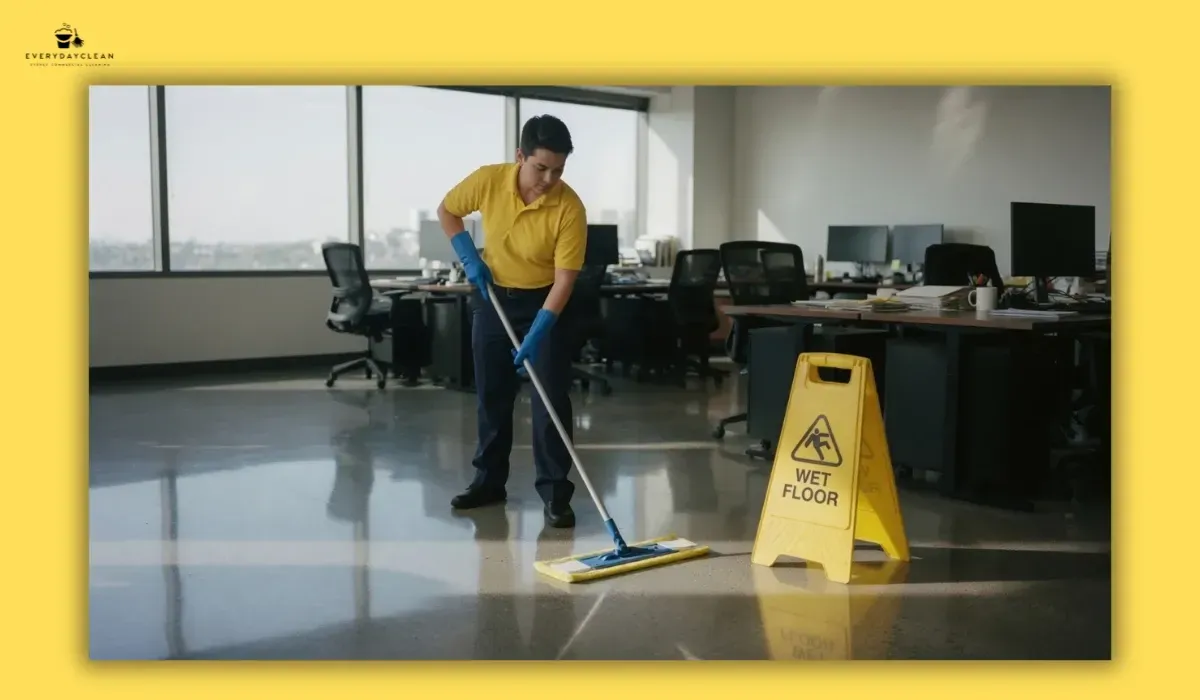
A regular clean keeps an office maintained and moves quickly because surfaces are already in reasonable condition. A deep clean resets the space and takes considerably longer because it reaches areas that routine cleaning skips.
Regular office cleaning usually covers:
- emptying bins and replacing liners
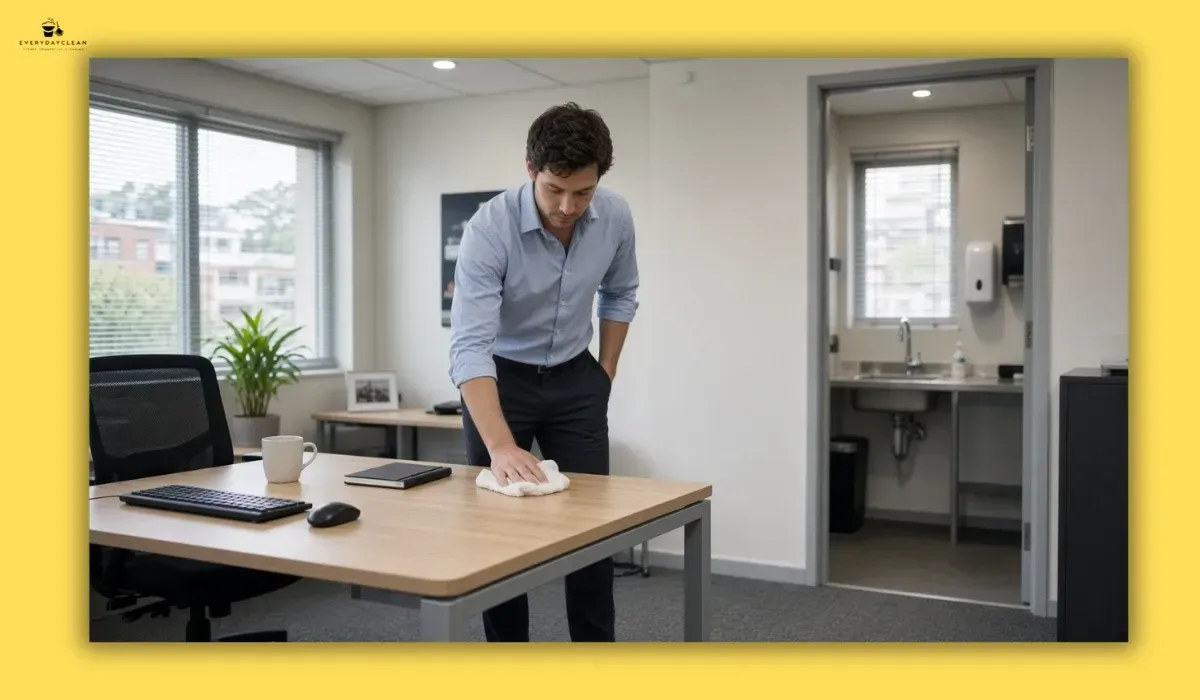
- wiping desks, shared surfaces and reception areas
- cleaning and sanitising bathrooms
- kitchen and breakroom wipe-down
- vacuuming carpets and mopping hard floors
- spot-cleaning glass and high-touch points
Deep cleaning adds more time-intensive work such as:
- detailed grout, skirting and edge cleaning
- carpet extraction or hard-floor scrubbing
- internal window and partition glass
- vents, blinds and light fittings
- appliance interiors and full kitchen degrease
- upholstery and chair cleaning
Why does deep cleaning take so much longer?
Deep cleaning targets built-up soil, restricted areas and specialised tasks that need dwell time, drying or equipment such as extractors. When done correctly, these tasks cannot be rushed, which is why a deep clean can take two to three times the hours of a standard service and is often scheduled quarterly or before an inspection.
What changes how long an office takes to clean?
Several factors move the estimate up or down. Understanding them helps a business plan a realistic schedule and avoid under-booking cleaning hours.
- Bathrooms and kitchens. These are the most time-heavy areas per square metre because of sanitising, restocking and detail work.
- Floor type. Carpet vacuuming is faster than mopping, sealing or scrubbing hard floors, and mixed flooring adds transitions.
- Bins and waste. More desks and kitchen points mean more bins to empty and reline.
- Current condition. A well-maintained office cleans faster than one that has fallen behind.
- Access and layout. Locked areas, security sign-in, lifts and narrow corridors all add minutes.
- After-hours cleaning. Cleaning an empty office is often more efficient than working around staff, though it may involve alarm and access steps.
- Frequency. Daily or several-times-weekly cleaning keeps each visit short, while infrequent cleaning lets soil build up and stretches each session.
- Clutter and personal items. Cleaners work around desks rather than moving belongings, so tidy surfaces speed the job.
How to estimate cleaner-hours versus clock time
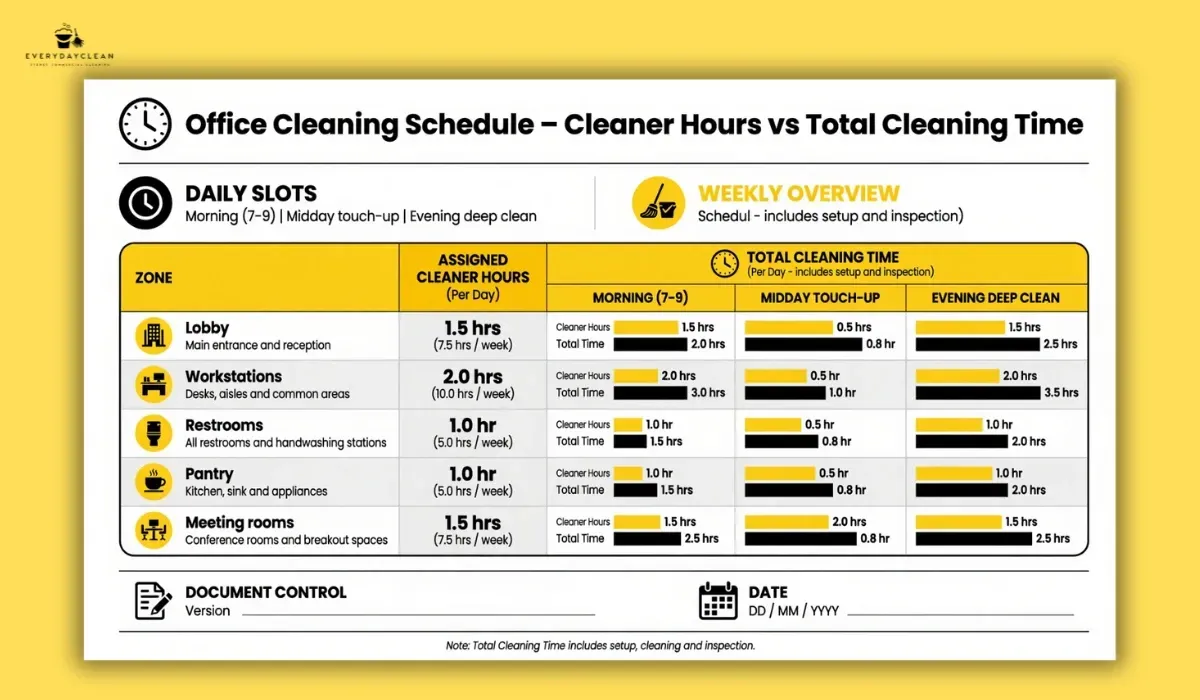
Cleaner-hours and clock time are not the same, and confusing them leads to scheduling errors. Cleaner-hours measure the total labour, while clock time is how long the visit actually runs.
If a medium office needs about 4 cleaner-hours, one cleaner takes roughly 4 hours on site, but a team of two can finish in about 2 hours of clock time. This matters when access is limited to a short after-hours window or a lease requires the building cleared by a set time. For larger sites, splitting a crew across zones is often the only way to fit the work into the available window.
How many cleaners does an office need?
It depends on the total cleaner-hours and the access window. A small office is usually a one-person job, a medium office may use one or two cleaners depending on timing, and a large or multi-floor site typically needs a team working in parallel. If cost planning is the priority, the commercial office cleaning cost guide explains how hours and scope translate into a quote.
Practical examples of office cleaning time
Examples help translate the ranges into real scheduling. These are planning illustrations, not fixed quotes.
- A 6-desk Sydney startup, cleaned twice a week. One cleaner, roughly 45 to 60 minutes per visit, covering bins, desks, one bathroom, a small kitchen and vacuuming.
- A 25-desk professional office, cleaned nightly after hours. One to two cleaners, around 1.5 to 2.5 hours, with two bathrooms, a shared kitchen and mixed flooring.
- A 50-desk multi-team floor, cleaned three times a week. A team of two to three, around 3 to 5 hours combined, with additional time when a periodic deep clean is scheduled.
- A quarterly deep clean of a medium office. Often a half to full day, including carpet extraction, detailed bathrooms and internal glass, on top of the regular routine.
When should a business book a professional cleaner?
Professional cleaning makes sense when in-house tidying no longer keeps the space presentable, when bathrooms and kitchens need consistent sanitising, or when a deep clean requires equipment such as carpet extractors. Regular professional cleaning also keeps each visit efficient because soil never builds up to the point where hours blow out.
A DIY or ad-hoc approach may suit a very small office with light use, but it tends to break down as headcount grows, foot traffic increases or hygiene expectations rise. If planning a schedule or comparing options for a Sydney workspace, professional
office cleaning in Sydney can be scoped to match the size, frequency and access window a business needs.
Frequently asked questions
How long does it take to clean a small office?
A small office of up to around 10 desks usually takes 45 minutes to 1.5 hours for a standard clean with one cleaner. The exact time depends on the number of bathrooms, kitchen size, floor type and how recently the space was last cleaned. A deep clean of the same office can take two to four hours.
How long does a deep clean of an office take?
An office deep clean generally takes two to three times longer than a regular clean because it covers detailed tasks such as carpet extraction, internal glass, vents and full kitchen degreasing. A medium office deep clean often runs half a day to a full day, depending on condition, scope and how many cleaners are working.
Is it faster to clean an office after hours?
Cleaning an empty office after hours is often more efficient because cleaners are not working around staff or occupied desks. After-hours work can involve alarm, access, and sign-in steps, so a little setup time is normal. The overall session still tends to run more smoothly than daytime cleaning.
Does cleaning frequency change how long each visit takes?
Yes. Frequent cleaning keeps each visit short because soil and clutter never build up, while infrequent cleaning lets grime accumulate and stretches each session. A daily or several-times-weekly schedule generally means shorter, more predictable visits than an occasional one.
Planning cleaning around a specific office size, scope and access window gives the most accurate time estimate. If it helps to map a schedule to a particular Sydney workspace, you can
talk it through with Everyday Clean to work out timing that suits your office.
Blog