How Should Chemicals Be Stored in Food Premises?
Chemicals should be stored in a dedicated, lockable cupboard or separate room, well away from food and packaging, kept in their original labelled containers, and positioned below food (never above or beside it), with a Safety Data Sheet (SDS) accessible on site for hazardous products. Safe chemical storage helps protect food from contamination and staff from harm, and supports the expectation under Australian food safety rules that cleaning chemicals do not contaminate food.
This guide focuses on storing and handling cleaning chemicals safely in food premises, commercial kitchens and canteens. It is not a general cleaning checklist, so for task lists see the linked kitchen guides, and for specific legal duties always confirm with your local council health inspector and the manufacturer's SDS.
Chemical storage in food premises sits under FSANZ and work health and safety rules
Chemical storage in food premises is shaped by two frameworks working together. Both set expectations rather than a single fixed method, so the detail depends on your premises and products.
- The Food Standards Australia New Zealand (FSANZ) Food Standards Code, Standard 3.2.2 and Standard 3.2.2A, sets general expectations that premises, equipment and food handling are kept clean and sanitary and that cleaning chemicals do not contaminate food. Standard 3.2.2A adds food safety management tools for many businesses in the food service and related sectors. The current standards are published on foodstandards.gov.au.
- Safe Work Australia model work health and safety guidance covers hazardous chemicals more broadly, including labelling, storage, spill containment and keeping an SDS accessible for staff. See the Safe Work Australia Managing risks of hazardous chemicals in the workplace code of practice on safeworkaustralia.gov.au.
This is general information, not legal advice, and it does not guarantee any audit outcome. Requirements vary by state, territory, and business type, so confirm your obligations with your local council or environmental health officer, the FSANZ Food Standards Code, and the manufacturer's SDS for each product.
Five essential best-practice rules for storing chemicals in food premises
The safest approach follows a few core best-practice rules. Treat these as a practical baseline for how chemicals should be stored in food premises, alongside the specific requirements confirmed by your local council and the manufacturer SDS.
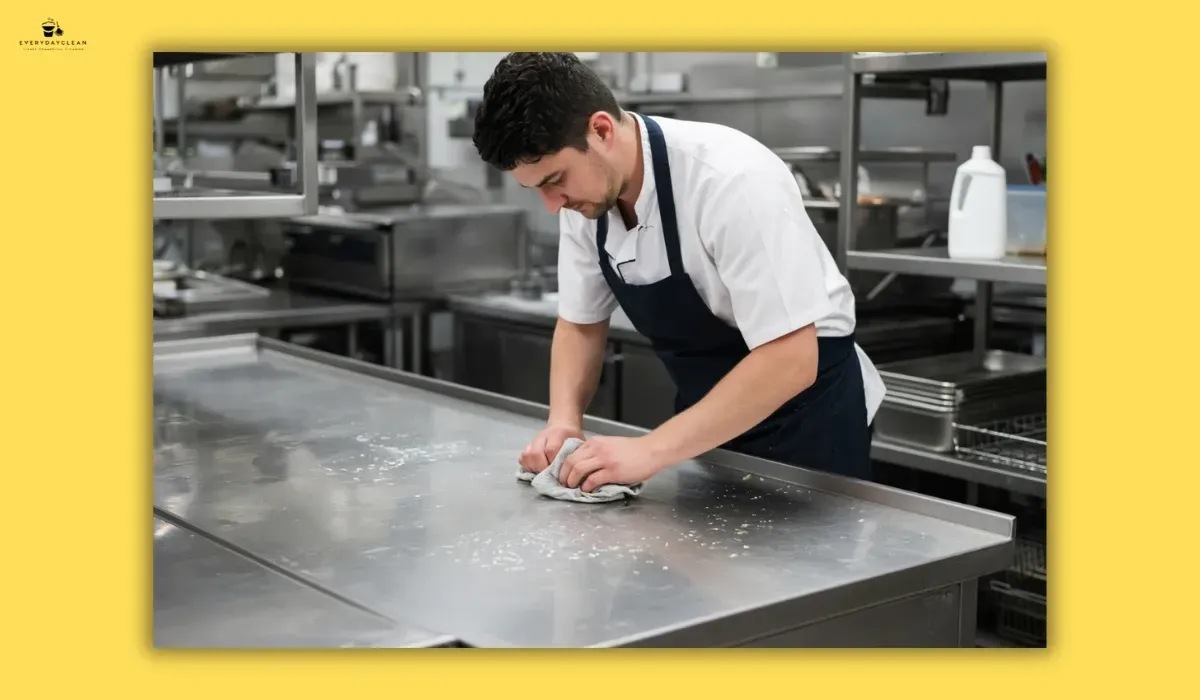
- Physical separation from food and prep areas: Store chemicals in a dedicated locked cupboard or separate room, never above or beside food, packaging, or utensils. Keep them below food level so a leak cannot drip onto food.
- Adequate ventilation: Keep the storage space cool, dry, and well-ventilated away from direct heat sources, and apart from food storage.
- Bunding and spill containment: Use spill trays or bunded shelving to catch leaks before they reach floors or drains.
- Strict secondary container labelling: Clearly label every decanted container or spray bottle with the chemical name and hazard warnings. Unlabelled or wrongly labelled containers are a common issue raised in inspections.
- Accessible Safety Data Sheets (SDS): Keep a current SDS on site and readily available for staff for each hazardous chemical used at the workplace, so they can check safe use, first aid and spill response quickly.
Cleaning and sanitation procedures in the food industry separate two distinct steps
Cleaning and sanitation procedures in the food industry rely on one key idea: cleaning and sanitising are two different actions, done in sequence, not one combined step.
- Cleaning removes visible dirt, grease and food waste using detergent and physical effort. A surface that still looks or feels soiled has not been cleaned, and sanitiser applied over that residue will not work properly.
- Sanitising reduces pathogens on an already-clean surface using a food-contact-safe sanitiser at the correct dilution and contact time. Contact time matters, so surfaces are usually left wet for the time stated on the label rather than wiped dry straight away.
This cleaning-then-sanitising order is the heart of food safety cleaning and sanitizing, and it matters here because each step uses a different chemical that must be correctly stored, labelled and diluted. For task-by-task routines, a commercial kitchen cleaning checklist sets out what to clean and how often, which complements the storage and handling focus here.
The 6 stages of cleaning food hygiene show where each chemical is used
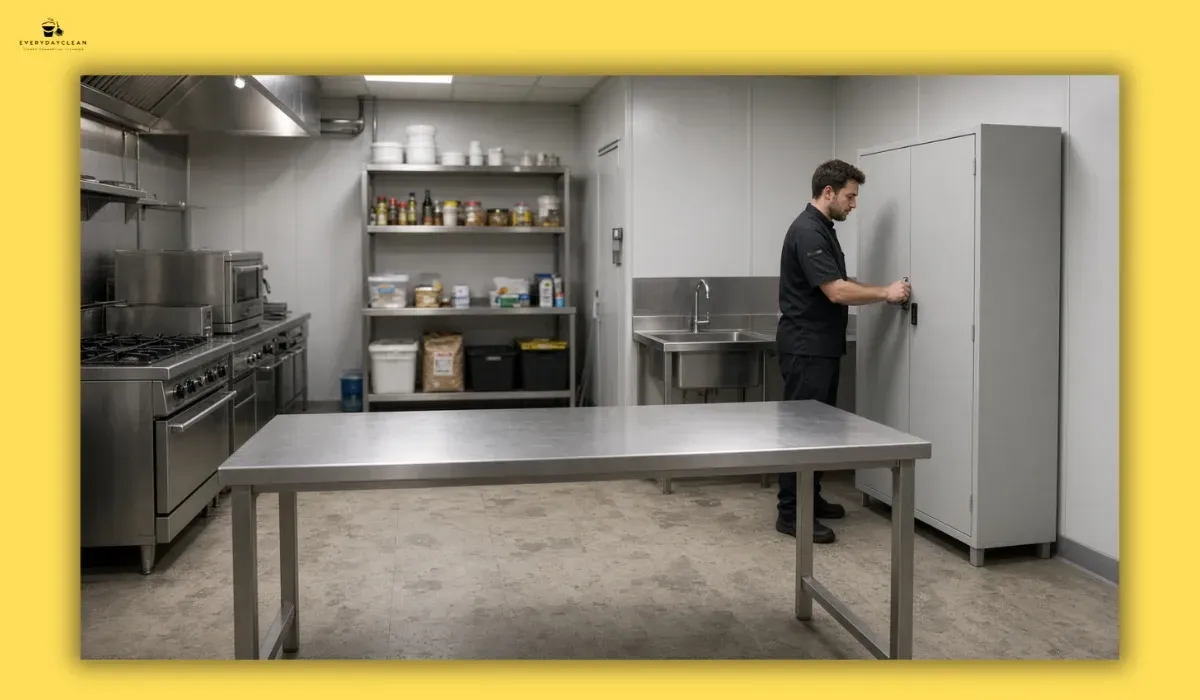
The 6 stages of cleaning food hygiene, a model widely used in UK food-safety training, map closely onto standard Australian kitchen practice. It is worth knowing here because it shows which chemical belongs at which step, which in turn guides what needs storing and labelling.
| Stage | What happens |
|---|---|
| 1. Pre-clean | Remove loose food waste and debris by scraping, wiping or rinsing |
| 2. Main clean | Apply detergent to loosen grease and remaining soil |
| 3. Rinse | Rinse off detergent and loosened soil |
| 4. Sanitise | Apply a food-safe sanitiser at the correct dilution and contact time |
| 5. Final rinse (if required) | Rinse per the sanitiser label, as some require it and some do not |
| 6. Dry | Allow to air dry or use clean, single-use materials |
Always follow the sanitiser label on whether a final rinse is needed, since food-contact sanitisers differ. The workflow only works when the correct, in-date chemicals are on hand and stored safely between uses.
Decanting, dilution and PPE safety prevent toxic cross-contact
Decanting and diluting chemicals is where many contamination risks appear, so clear rules protect both food and staff.
- Never reuse food or drink containers for chemicals. An empty sauce bottle or drink bottle holding decanted chemical is a serious poisoning risk and should never be used this way in a food premises.
- Label every spray bottle and secondary container with the product name and hazard details, even for water-diluted solutions.
- Dilute to the manufacturer's stated ratio using the SDS and label, since too strong can be unsafe and leave residue, and too weak may not sanitise effectively.
- Never mix chemicals, especially bleach with acids or ammonia, as this can release toxic gases. Store incompatible products apart.
- Use the PPE named on the SDS, such as gloves and eye protection, and ensure good ventilation when decanting or using concentrates.
These handling habits reduce the risk of toxic cross-contact, where a chemical transfers to food, hands, or surfaces it should never reach.
Inspection and audit readiness depend on daily checks and trained staff
Staying inspection-ready is about routine, not a last-minute scramble before an audit. Consistent daily habits keep chemical storage safe and demonstrable.
- Run daily checks that chemicals are stored in the right place, containers are sealed and labelled, and nothing is stored above or near food.
- Keep a stocked, accessible spill kit suited to the chemicals on site, and make sure staff know where it is.
- Keep the SDS folder or digital access current, with a sheet for every hazardous chemical in use.
- Train staff on storage rules, correct dilution, labelling, safe handling and spill response, and refresh this regularly.
- Keep simple records of checks, training and any incidents, which help show a consistent approach.
What our cleaners often see in Sydney kitchens: sanitiser decanted into unlabelled spray bottles, a degreaser stored on a shelf above a prep bench, and SDS folders that are out of date. These are usually quick to fix once the storage area is set up properly and staff know the routine.
For broader back-of-house standards, a commercial kitchen health and safety guide covers how cleaning, chemicals and safety fit together across the kitchen. While daily chemical storage and handling stay with the food business team, professional commercial cleaning support can take care of periodic deep cleaning and back-of-house work around that routine. None of this guarantees a pass, but it supports a safer premises and a smoother inspection.
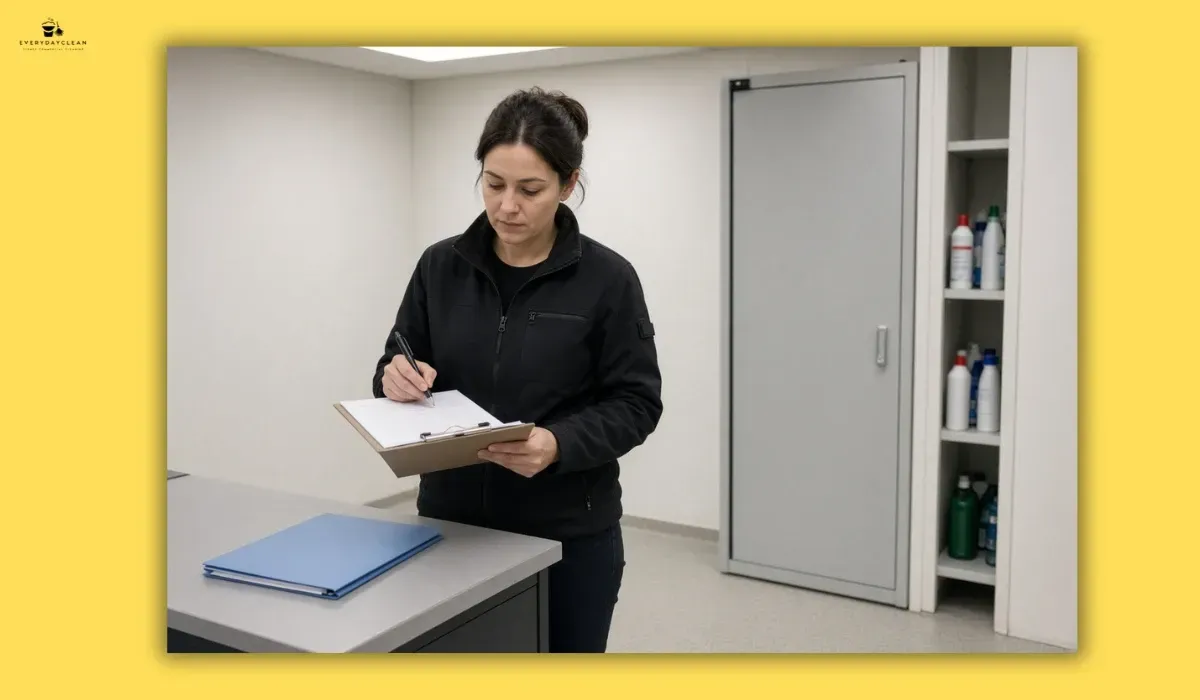
How should chemicals be stored in food premises: common questions
Where should cleaning chemicals be stored in a commercial kitchen?
Cleaning chemicals should be stored in a dedicated locked cupboard or a separate room, away from food, packaging, utensils and food-contact surfaces. Keep them below food level, never above it, in a cool, well-ventilated space with spill containment. The area should be clearly separated from all food storage and preparation zones.
Can chemicals be stored above or next to food?
It is strongly advised against. Chemicals should never be stored above or directly beside food, packaging or food-contact surfaces, because a leak, spill or splash can contaminate food. Storing chemicals below food level and in a separate, contained area is a widely followed best practice and a common point raised during inspections.
Why must chemicals stay in their original labelled containers?
Original containers carry the correct product name, hazard information and usage instructions, which staff and inspectors rely on. If a chemical is decanted, the new container should be clearly labelled with the product name and hazard details. Unlabelled or reused food containers are unsafe and are a common issue raised in inspections.
What is the difference between cleaning and sanitising in food premises?
Cleaning removes visible dirt, grease and food waste with detergent and effort. Sanitising then reduces pathogens on an already-clean surface using a food-safe sanitiser at the correct dilution and contact time. Cleaning always comes first, because sanitiser applied over residue will not work properly. Both steps are needed, not one or the other.
Do food premises need a Safety Data Sheet for cleaning chemicals?
Generally yes for hazardous chemicals. An accessible, current Safety Data Sheet (SDS) should be kept on site for each hazardous chemical used at the workplace, so staff can quickly check safe use, dilution, first aid and spill response. Some everyday consumer products in household quantities can be treated differently, so check the product and your WHS obligations. Keeping SDS access up to date supports safe handling during daily use and emergencies.
Keeping food premises compliant with routine chemical audits
Safe chemical storage holds up when it is checked regularly, not set once and forgotten. The strongest food premises run short, routine chemical audits rather than relying on memory or a single annual review.
A practical routine is a quick daily visual check of storage, labelling and spill readiness, a monthly review of the SDS folder and stock, and a periodic staff refresher on handling and dilution. Pair that with the FSANZ Food Standards Code, the manufacturer SDS and guidance from your local council health inspector, and chemical storage stays both safe and ready to demonstrate at any inspection.
About Everyday Clean
Everyday Clean is a Sydney-based cleaning company supporting commercial kitchens, hospitality venues and businesses with commercial and back-of-house cleaning. Food safety compliance, chemical handling and audit obligations remain the responsibility of the food business operator, guided by FSANZ, the SDS and local council requirements.
Blog