Commercial Kitchen Exhaust Hood Cleaning Best Practices
Commercial kitchen exhaust cleaning covers the removal of grease and residue from the hood and canopy, the filters, the accessible sections of the duct system, and the exhaust fan, so the whole system keeps drawing air and grease away from the cooking line. For a restaurant, cafe or any commercial kitchen, this is planned maintenance rather than a one-off task, because grease builds up continuously during service and collects in places routine wiping never reaches. Planning it around how much greasy cooking the kitchen does, rather than waiting for a problem, is what keeps the system working and the risk manageable.
This guide is for operators, kitchen managers and facility managers deciding how to approach exhaust system cleaning. It is not about domestic rangehoods or home kitchens, which are a different scale and a different task entirely. The focus here is the commercial exhaust system, why it needs a plan, and how to work with a specialist who cleans it.
What a Commercial Exhaust System Includes
A commercial kitchen exhaust is a connected system, not a single appliance, and grease travels through all of it. Understanding the parts helps clarify what cleaning does and does not reach.
| Component | Role | Cleaning consideration |
|---|---|---|
| Hood and canopy | Captures grease-laden air and vapour above the cooking line | Accessible surfaces are cleaned regularly; heavy build-up needs a deeper clean |
| Filters | Trap grease from the extracted air | Cleaned or soaked frequently, often the most routine task |
| Grease trays and cups | Collect dripping grease | Emptied and cleaned as part of daily upkeep |
| Ductwork | Carries extracted air away from the kitchen | Concealed and harder to reach, usually a specialist task |
| Exhaust fan | Draws air through the system | Grease accumulates on and around the fan, affecting airflow |
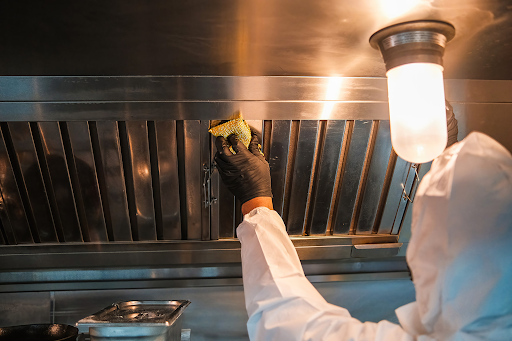
The hood, canopy, filters and grease trays are the visible, accessible parts a kitchen team or general cleaner can help maintain, depending on scope and site requirements. The ductwork and fan are where grease concentrates out of sight, which is why they generally fall to a specialist commercial kitchen exhaust cleaner with the right access equipment.
Grease, Odour, Airflow and Fire Risk
Grease is the reason the system needs regular attention. As it accumulates, it affects the kitchen in several connected ways, and these are the practical reasons operators plan cleaning rather than leave it.
Build-up reduces airflow, so the extraction system works harder and pulls heat, smoke and vapour away from the cooking line less effectively. That can make the kitchen hotter, smokier and less comfortable, and can let cooking odours linger and travel. Grease accumulation in the concealed parts of the system is also a recognised fire risk in commercial kitchens, which is why exhaust cleaning is treated as a maintenance priority rather than a presentation task. Regular cleaning helps manage that risk, but no cleaning can be said to guarantee against fire or to guarantee compliance, and it should not be presented that way.
What Professional Cleaning May Include
A professional exhaust clean usually reaches further into the system than routine kitchen maintenance. Scope varies between contractors and kitchens, so it is worth confirming exactly what a given service covers.
Depending on the arrangement, professional commercial kitchen exhaust cleaning may include degreasing the hood and canopy surfaces, cleaning or replacing filters, clearing grease trays, cleaning accessible sections of ductwork, and cleaning the exhaust fan and surrounding components. Access panels may be used to reach concealed sections that routine cleaning cannot. Some services also provide cleaning records and notes on the system's condition, which are useful for planning and for any conversations with an insurer or landlord.
Fan, Filter, Canopy and Duct Checks
Beyond cleaning, a good service looks at the condition of the system, not just its cleanliness. Practical checks across the main components help catch issues early.
On the filters, the focus is whether they are intact, seating correctly and being cleaned often enough for the kitchen's grease load. On the canopy and hood, it is the extent of build-up on accessible and less accessible surfaces. On the ductwork, it is how much grease has concentrated in the concealed runs, which usually needs specialist access to assess. On the fan, it is grease accumulation affecting airflow and any signs the component is not running as it should. These are observations that inform cleaning and maintenance planning, and anything suggesting a fault is a matter for a qualified technician rather than a cleaning decision.
Cleaning Frequency as a Risk-Based Decision
There is no single correct interval for exhaust cleaning, because the right frequency depends on how the kitchen is used. A high-volume kitchen doing heavy frying, grilling or charbroiling accumulates grease far faster than a kitchen with lighter, lower-grease cooking, so the two should not follow the same schedule.
As a general planning guide, filters and accessible hood surfaces are often cleaned daily to weekly in busy kitchens, while concealed duct and fan cleaning is carried out periodically based on grease load. These are cautious ranges, not fixed rules or a universal promise. Because requirements can vary by kitchen type, insurer, landlord and equipment, confirm the intervals that apply to your premises with the relevant authority, your insurer, your landlord and the equipment manufacturer, rather than relying on a general figure. Broader commercial kitchen hygiene guidance sits alongside exhaust cleaning as part of an overall kitchen maintenance approach.
Records, Inspection Notes and Questions for a Contractor
Keeping a record of exhaust cleaning is practical for planning and for demonstrating that maintenance is happening. Cleaning dates, the scope of each clean, and any notes on the system's condition build a useful history over time, and these records are often relevant to insurers and landlords.
When engaging a contractor, it helps to ask what the service actually covers, which parts of the system are reached, whether access panels are used for concealed ducting, what is documented afterward, and how the recommended frequency is judged for your kitchen. Asking how condition issues are reported, and to whom, is also worth clarifying, since a cleaner is not a repair technician. Clear answers up front make it easier to judge whether a service matches the system's needs.
Cleaning, Inspection, Repair and Replacement Are Different
It helps to separate four distinct things, because they are sometimes blurred together. Cleaning removes grease and residue from the system. Inspection is an assessment of condition, which may be carried out by different qualified parties depending on what is being checked. Repair addresses a fault or damage, and replacement swaps out a component that has reached the end of its service life.
A cleaning service focuses on the first of these and may note conditions that suggest the others are needed. It does not replace a formal inspection, a repair by a qualified technician, or a manufacturer's maintenance requirements. Treating them as separate keeps expectations clear and helps ensure the right person handles each task.
When DIY Cleaning Is Unsuitable
Kitchen staff can maintain the accessible parts of the system, including filters, hood surfaces and grease trays, following the equipment guidance. Deeper cleaning is a different matter. Cleaning inside the ductwork and around the exhaust fan usually requires dismantling access points, specialist equipment and safe methods, and attempting it without these can leave concealed grease in place or miss documentation that a kitchen may need.
A specialist commercial kitchen exhaust cleaner is the safer choice for the concealed system, for heavy or hardened grease, and wherever access is difficult. Where a kitchen wants its wider cleaning coordinated alongside exhaust maintenance, general commercial cleaning support can cover the kitchen and accessible surfaces, while the concealed exhaust system remains a specialist task handled separately.
A Safer Exhaust Cleaning Plan Starts With the System's Risk Profile
Planning commercial kitchen exhaust cleaning well means matching it to the system and how hard the kitchen works it: maintain the accessible hood, filters and trays regularly, arrange specialist cleaning of the concealed ducts and fan on a frequency that reflects the grease load, and keep records of what was done. Because intervals and requirements vary, confirming them with the relevant authority, insurer, landlord and equipment manufacturer is what grounds the plan in your actual premises rather than a general rule. Where the concealed system or heavy grease is involved, a specialist is the safer path, and coordinating that alongside the kitchen's wider cleaning keeps the whole environment on a steady footing.
Blog