Childcare Cleaning Products: Safe & Compliant Guide
Childcare cleaning products are specialised hygiene agents - detergents, disinfectants, sanitisers, and surface cleaners - formulated to eliminate pathogens in early learning environments without exposing children to toxic chemical residues. Unlike standard commercial cleaners, products used in childcare centres must meet the dual standard of being genuinely effective against bacteria and viruses while being safe for children whose immune systems and neurological development are still forming.
In Australia, the regulatory framework for childcare cleaning products is governed by ACECQA (Australian Children's Education and Care Quality Authority), the Therapeutic Goods Administration (TGA), and the NHMRC publication Staying Healthy: Preventing Infectious Diseases in Early Childhood Education and Care Services. Together, these authorities define which products are approved, how they must be used, and how staff must be trained in their application.
Everyday Clean's childcare cleaning specialists have worked with centres across Sydney for over 20 years, applying childcare cleaning services that align with these standards. The guide below breaks down what to look for, what to avoid, and how to build a compliant, child-safe cleaning program for every zone in a centre.
What Makes a Childcare Cleaning Product Safe and Compliant in Australia?
A childcare cleaning product is considered safe and compliant in Australia when it satisfies three distinct criteria: ingredient safety for children, proven efficacy against pathogens common in early childhood settings, and alignment with the regulatory standards set by ACECQA and the TGA.
- Ingredient safety refers specifically to the absence of compounds known to cause harm to young children at typical exposure levels. Children are disproportionately vulnerable to chemical exposure compared to adults - pound for pound of body weight, they breathe more air, drink more water, and absorb more through skin contact. Volatile organic compounds (VOCs), ammonia, phenols, chlorinated solvents, and synthetic fragrances all fall into the
- category of ingredients that pose documented risks, including respiratory irritation, endocrine disruption, and aggravation of childhood asthma.
- Efficacy means the product demonstrably kills or inactivates target pathogens. In Australian childcare settings, the primary pathogens of concern are gastroenteritis viruses (norovirus, rotavirus), respiratory viruses, and bacterial threats including Staphylococcus aureus and E. coli. For a disinfectant to make valid efficacy claims in Australia, it must be registered with the TGA - registration demonstrates the product has been tested and shown to work as labelled under real conditions.
- Regulatory compliance under ACECQA's National Quality Framework requires centres to demonstrate that cleaning products and procedures minimise infection risk and support child wellbeing. ACECQA Quality Area 2 (Children's Health and Safety) and Quality Element 3.2.3 (Environmental Responsibility) both directly relate to product selection - centres choosing TGA-registered, non-toxic, biodegradable cleaning products are better positioned across both quality elements.
Which Chemicals Should Childcare Cleaning Products Never Contain?
Not all cleaning products labelled "safe for families" or "eco-friendly" are appropriate for childcare environments. Vague marketing language on product labels does not constitute regulatory approval. The following chemical classes are specifically flagged as inappropriate for childcare cleaning by Australian and international health authorities:
- Benzalkonium chloride - a quaternary ammonium compound found in many "spray and walk away" disinfectants. While broadly antimicrobial, it is a known skin and respiratory sensitiser, and residual surface contact by young children has been linked to dermatitis and asthma exacerbation.
- Ammonia - commonly found in glass and surface cleaners; toxic if inhaled in enclosed spaces and corrosive to mucous membranes. Children playing near recently cleaned surfaces may inhale residual fumes at concentrations higher than those of adults at the same height.
- Phenols and phenolic compounds - disinfectants containing phenol are effective but are classified as toxic if swallowed, a critical risk given that young children routinely mouth toys and surfaces.
- Phthalates and synthetic fragrances - phthalates are endocrine-disrupting compounds found in some scented cleaning products. The American Academy of Paediatrics, whose research is cited widely in Australian childcare policy, specifically recommends avoiding synthetic fragrance in childcare cleaning products.
- Formaldehyde-releasing preservatives - found in some disinfectant wipes and surface sprays; classified as a probable carcinogen and potent respiratory irritant at chronic low-level exposure.
- Phosphates - not directly toxic but environmentally harmful and associated with algal bloom in waterways when cleaning wastewater is discharged through stormwater systems. ACECQA's environmental responsibility element explicitly addresses the environmental impact of cleaning products.
The practical test is simple: if a product label carries the words "danger" or "flammable", requires a ventilated room during use, or instructs wearing eye protection, it is not appropriate for routine use in a childcare facility. For a direct breakdown of verified
child-safe disinfectants
by application type, Everyday Clean's product guide covers the specific formulations used in compliant centre cleaning.
What Are the Best Childcare Cleaning Products for Each Zone?
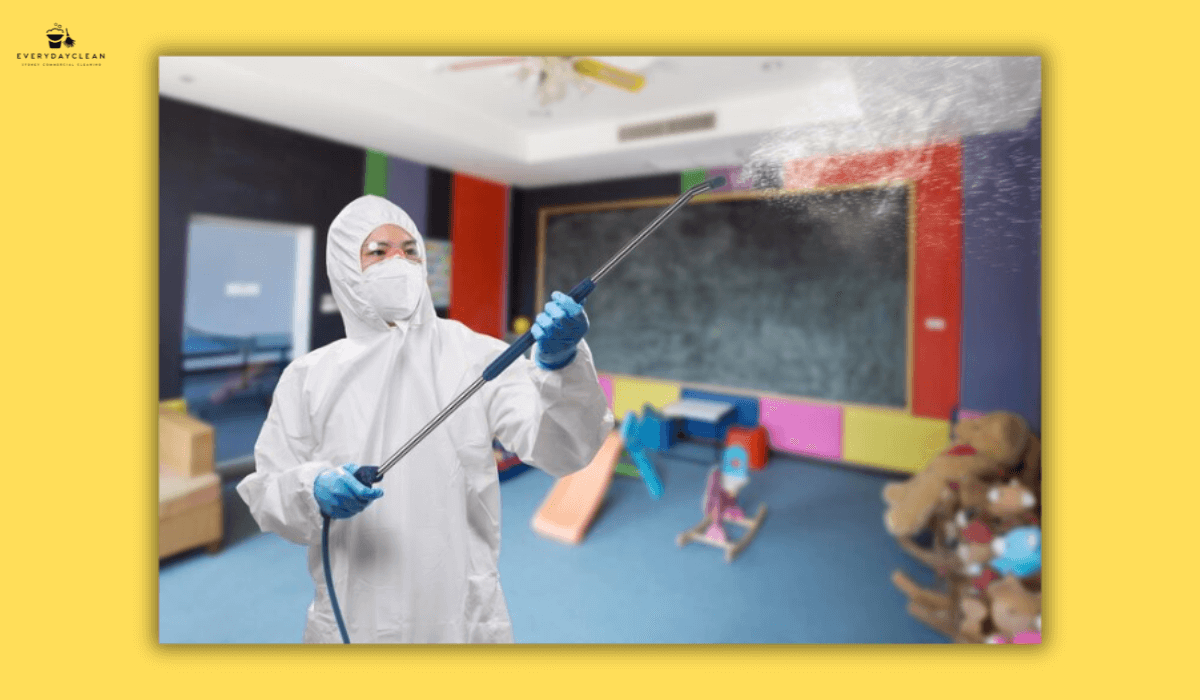
A well-structured childcare cleaning product program is zone-specific - not every surface requires the same treatment, and using a hospital-grade disinfectant on a toy that will go straight into a toddler's mouth is as inappropriate as using a mild detergent on a nappy change station. The table below maps product type to zone and frequency. For a complete, printable task breakdown, see the daily cleaning checklist for childcare centres from Everyday Clean.
| Zone | Product Type | Minimum Frequency |
|---|---|---|
| Toys and play equipment | pH-neutral all-purpose cleaner + rinse | Daily (mouthed toys: after each use) |
| Nappy change surfaces | TGA-registered hospital-grade disinfectant | After every change |
| Kitchen benches and food prep | Food-safe sanitiser (no rinse required) | Before and after food handling |
| Bathrooms and toilet areas | Hospital-grade disinfectant + surface cleaner | At least twice daily |
| High-touch surfaces (door handles, light switches, taps) | TGA-registered disinfectant wipes or spray | At minimum twice daily; more during illness outbreaks |
| Hard floors | pH-neutral floor cleaner (non-slip residue) | Daily |
| Soft furnishings and rugs | Vacuuming + periodic laundering | Vacuum daily; launder weekly |
The most important product category distinction in childcare is between cleaning and disinfecting. Cleaning physically removes dirt, organic matter, and most surface contamination. Disinfecting kills residual pathogens after cleaning. The NHMRC's Staying Healthy guide is explicit: disinfection is only effective after cleaning - applying a disinfectant to a dirty surface is significantly less effective because organic matter neutralises the active agent.
What Childcare Cleaning Products Are Safe for Toys?
Toys are the highest-risk vector for pathogen transmission in early learning environments because they are shared constantly, handled by multiple children, and routinely mouthed, licked, and chewed. A pH-neutral all-purpose cleaner - ideally unscented and free from bleach and ammonia - is the correct product for daily toy cleaning. For a detailed frequency guide broken down by toy type and age group, see Everyday Clean's resource on how often daycares should clean toys. The cleaning method matters as much as the product: toys should be submerged or wiped with cleaning solution, rinsed thoroughly with clean water, and allowed to air dry before being returned to the play area.
For mouthed toys specifically, the NHMRC recommends removing them from the play area immediately and completing a full clean-and-sanitise cycle before reuse. Using a mild sodium hypochlorite solution at 0.1% concentration (a diluted bleach solution) is acceptable for toy sanitisation under NHMRC guidance, but the toy must be rinsed after sanitisation and allowed to dry. TGA-registered disinfectant wipes designed for use in childcare settings are an efficient alternative for this process during busy periods.
What Childcare Cleaning Products Are Safe for Nappy Change Areas?
Nappy change areas represent the single highest cross-contamination risk zone in any childcare centre. Faecal pathogens, including norovirus, rotavirus, and coli, can survive on hard surfaces for hours to days, and the change station surface is touched repeatedly by educators and children throughout the day. The only appropriate disinfectant for this zone is a TGA-registered hospital-grade disinfectant with a documented kill claim against the relevant pathogens - not a general-purpose cleaner, and not an eco-friendly product that lacks TGA registration.
The correct protocol is: remove waste, clean the surface with detergent and water, apply the disinfectant at the correct concentration per the label, allow the required contact time (typically 30 seconds to 2 minutes depending on the product), and wipe or allow to air dry. Colour-coded cleaning cloths - a dedicated colour for the change area, never used elsewhere - prevent cross-contamination between zones.
How Should Childcare Cleaning Products Be Stored and Used Safely?
Effective childcare cleaning products are, by their nature, still chemical agents - even non-toxic, biodegradable formulations must be stored and handled correctly. ACECQA's guidelines and Australia's Work Health and Safety Act 2011 both impose specific obligations on centres regarding chemical storage, dilution, and staff training.
Cleaning products must be stored in a locked cabinet that is inaccessible to children - not on a shelf, not under a sink without a childproof latch, and not in the same room where food is stored or prepared. Safety Data Sheets (SDS) for every cleaning product used in the centre must be on file and accessible to staff.
Concentrated products must be diluted according to the manufacturer's label instructions. Overconcentration does not improve efficacy - it increases chemical residue on surfaces and staff exposure risk. Dilution dispensers mounted on the wall, as used by professional cleaning services, eliminate guesswork and significantly reduce chemical waste and cost.
Staff training on correct product use, contact times, and colour-coded cloth systems is not optional under WHS obligations. A cleaner who does not understand contact time - the minimum duration a disinfectant must remain wet on a surface to achieve its kill claim - is not achieving disinfection regardless of the product quality.
FAQs About Childcare Cleaning Products
Below are the questions most frequently asked by centre directors, educators, and parents when reviewing cleaning product choices for early childhood environments. These questions reflect genuine safety concerns and compliance uncertainties that arise in practice.
Can you use bleach as a childcare cleaning product in Australia?
Bleach - sodium hypochlorite - can be used as a childcare cleaning product in Australia, but only at specific dilutions and in specific zones. NHMRC's Staying Healthy guide recommends a 0.1% sodium hypochlorite solution for general surface sanitisation and a 0.5% solution for bodily fluid spills. At these concentrations, bleach is effective against the primary viral and bacterial pathogens in childcare settings. The critical requirements are: never use bleach on surfaces where children will immediately have contact without rinsing, never mix bleach with other cleaning products (particularly ammonia, which produces toxic chloramine gas), always use bleach in a ventilated area, and store bleach in its original container in a locked cabinet. For routine daily cleaning of most surfaces, a pH-neutral detergent is preferable to bleach - bleach should be reserved for disinfection tasks in high-risk zones rather than used as a general cleaner.
What childcare cleaning products need to be TGA-approved in Australia?
In Australia, any product that claims to kill, destroy, or inactivate microorganisms - bacteria, viruses, fungi, or spores - must be registered with the TGA to make those claims legally. This means all disinfectants and hospital-grade sanitisers used in childcare settings should carry a TGA registration number (ARTG number) on the label. Products without this number cannot legally claim disinfectant efficacy, regardless of what the marketing language suggests. General-purpose detergents and surface cleaners used for dirt and debris removal do not require TGA registration because they do not claim microbial kill. The distinction matters in practice: a childcare centre using an unregistered "natural" spray and claiming it disinfects toys or change tables would not be meeting the ACECQA standard for infection control, and would be at risk during a licensing inspection or disease outbreak investigation.
Are eco-friendly and non-toxic cleaning products effective enough for childcare centres?
Eco-friendly and non-toxic cleaning products can meet the efficacy standards required for childcare centres, but only when they carry TGA registration for their disinfectant claims. The misconception is that effectiveness and safety are in tension - in fact, TGA-registered non-toxic disinfectants such as hypochlorous acid-based products and certain enzyme-based disinfectants achieve hospital-grade pathogen kill without toxic chemical residue. Hypochlorous acid, for example, is produced naturally by the human immune system and breaks down to saltwater after disinfecting - it is registered by the TGA as effective against SARS-CoV-2, norovirus, and Staphylococcus aureus, while being rated non-hazardous and non-corrosive. The key is to verify TGA registration rather than relying on "eco" or "green" label claims, which are unregulated marketing terms in Australia and carry no regulatory weight.
How often should childcare cleaning products be applied to toys?
Toys should be cleaned with a pH-neutral detergent and sanitised daily as a minimum standard. Mouthed toys - any toy that a child has had in their mouth - must be removed from the play area and cleaned and sanitised before another child uses them. This is not a best practice recommendation; it is a requirement under the NHMRC Staying Healthy guidelines that form the basis of ACECQA compliance assessments. In practice, this means having a designated "mouthed toy" container where items go during the session, then processing them through a cleaning and sanitisation cycle before the next group. Hard plastic toys can be washed in warm water with a pH-neutral detergent and sanitised with a diluted sodium hypochlorite solution or TGA-registered sanitiser. Soft toys and fabric items should be laundered weekly at the warmest appropriate temperature setting, or more frequently if soiled or during illness outbreaks.
When Should a Childcare Centre Use a Professional Cleaning Service?
Maintaining a compliant cleaning product program in a busy childcare environment is a significant operational responsibility. The daily cleaning tasks that educators manage during operational hours are distinct from the deep cleaning, disinfection, and product compliance audit that professional cleaning services provide outside of hours.
Everyday Clean's childcare cleaning services are delivered by a team of 20 police-checked professionals with over 20 years of experience in early learning environments across Sydney. All products used meet TGA registration requirements and ACECQA compliance standards. Services include zone-specific commercial cleaning specialists with colour-coded systems, hospital-grade disinfection of high-risk areas, and floor care using pH-neutral cleaners that leave no slip hazard residue.
For centres that need to demonstrate cleaning compliance during ACECQA assessments, or following a gastroenteritis or respiratory illness outbreak, professional deep cleaning with documented product usage and Safety Data Sheet records provides the evidence trail that licensing authorities require.
Blog