What Is Commercial Cleaning? Services, Costs and Inclusions
Commercial cleaning is the professional cleaning and maintenance of workplaces such as offices, retail stores, warehouses and clinics, covering tasks like floor care, surface disinfection, waste removal and restroom sanitising on a scheduled basis. Unlike a one-off home clean, it follows a structured scope of work, runs on a set schedule, and is priced and delivered differently depending on the type of business and space involved.
This guide breaks down what commercial cleaning actually includes, how it differs from residential cleaning, what it typically costs in Australia, and how to judge whether a provider's scope of work covers what your business actually needs.
What's Included in a Standard Commercial Cleaning Service
Most standard commercial cleaning visits cover a similar core scope, though exact inclusions vary by provider and contract.
- Floor care: vacuuming, sweeping and mopping across carpet, tile, vinyl and hard flooring.
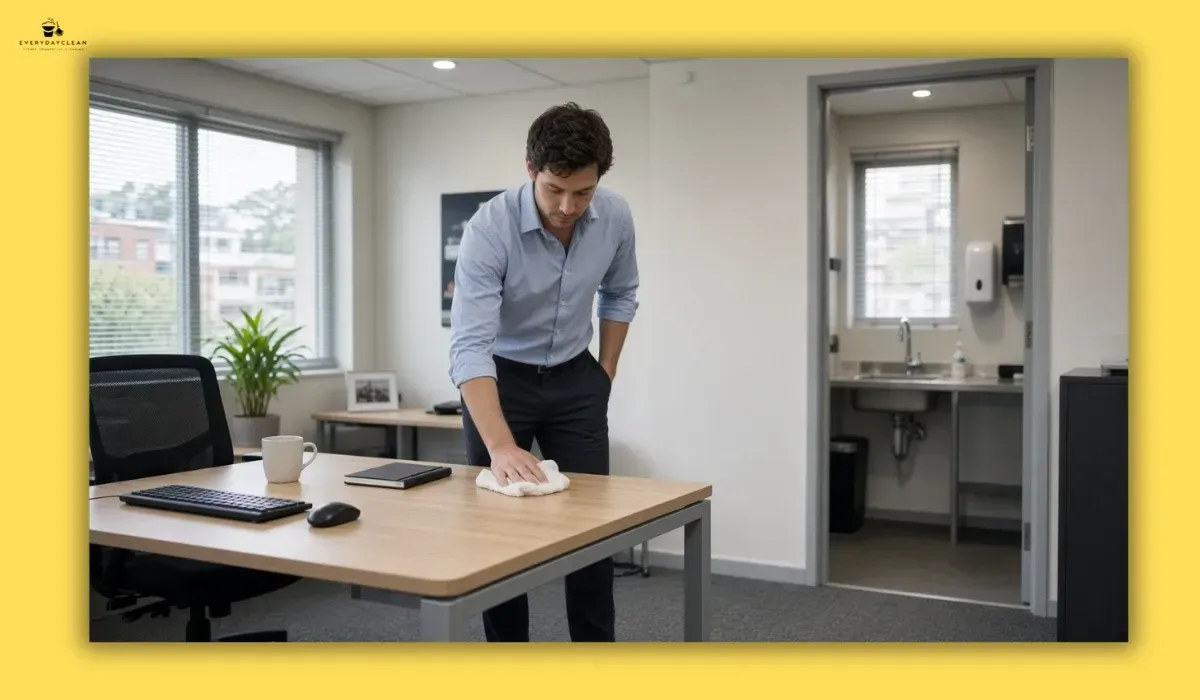
- Surface wiping and disinfection: desks, counters, shared tables and high-touch points such as door handles, light switches and lift buttons.
- Restroom cleaning: toilet and basin sanitising, mirror cleaning, and restocking of consumables like soap and paper towel.
- Waste management: emptying bins, replacing liners and separating recyclables where applicable.
- Kitchen or break room cleaning: wiping benches, cleaning sinks and general tidying of shared food areas.
- Entry and reception presentation: dusting, glass spot-cleaning and general tidying of client-facing areas.
Deeper tasks such as carpet extraction, window cleaning, upholstery cleaning or high-touch disinfection beyond the daily scope are commonly quoted as add-ons rather than included in a standard visit. It's worth confirming exactly what's in scope before comparing quotes between providers, since "standard cleaning" can mean different things depending on the company.
Ask for a written scope of work listing exactly which tasks are included at each visit and which are priced separately. This avoids disputes later about what "standard cleaning" was supposed to cover.
Commercial Cleaning vs Residential Cleaning
| Factor | Commercial cleaning | Residential cleaning |
|---|---|---|
| Setting | Offices, retail, warehouses, clinics and other workplaces | Private homes and apartments |
| Scope | Structured, scheduled scope of work covering shared and high-traffic areas | Flexible, tailored to the household's preferences |
| Frequency | Often daily, several times a week, or after-hours | Usually weekly, fortnightly or one-off |
| Equipment | Commercial-grade equipment such as floor buffers and industrial vacuums | Standard household vacuums and tools |
| Compliance | May need to align with workplace hygiene expectations, particularly in healthcare, food service or education settings | Generally no formal compliance requirement |
| Pricing | Quoted hourly, per square metre, or as a fixed contract | Usually quoted per visit or per hour |
The main practical difference is consistency and scale. A commercial cleaning provider works to a defined checklist on a repeatable schedule across shared spaces, while residential cleaning is more personalised and adjusts easily visit to visit.
Types of Commercial Cleaning Services
Commercial cleaning isn't one uniform service. The right type depends on the industry and the specific risks or presentation standards involved.
- Office cleaning: routine surface sanitising, floor maintenance and restroom hygiene for workstations and shared office areas.
- Retail and showroom cleaning: floor care, glass and display cleaning, and high-touch point disinfection to maintain a customer-ready presentation.
- Warehouse cleaning: removal of dust, oil residue and debris to support workplace safety and equipment longevity in industrial settings.
- Medical cleaning: cleaning focused on infection control expectations in clinics, treatment rooms and waiting areas. Facilities with specific compliance obligations should confirm requirements with the relevant health authority rather than assuming a standard commercial clean meets them.
- Strata cleaning: common areas such as lobbies, corridors, lifts and shared amenities in multi-tenant buildings.
- Child care cleaning: cleaning tailored to high-touch, high-traffic environments used by children, generally with extra attention to hygiene in shared spaces.
What Does Commercial Cleaning Cost in Australia?
Commercial cleaning is typically priced in one of three ways, and the right model depends on the size and predictability of the job.
| Pricing model | How it works | Best suited to |
|---|---|---|
| Hourly rate | Roughly $30 to $50 per hour, based on current Australian market examples | Small offices, irregular workloads, simple layouts |
| Per square metre | Roughly $1.50 to $3.50 per m², based on current Australian market examples | Larger, structured spaces needing predictable monthly budgeting |
| Fixed contract | Negotiated flat fee based on scope, frequency and site size | Ongoing scheduled cleaning across offices, retail or strata buildings |
These are general planning ranges, not fixed prices. Actual cost depends on floor area, cleaning frequency, the specific tasks included, and the type of facility, so a written, site-specific quote is the only way to get an accurate figure. Larger spaces and more frequent contracts commonly attract a lower per-visit rate than one-off or infrequent cleans.
How to Choose a Commercial Cleaning Provider
- Confirm the scope of work in writing. A clear list of included tasks, frequency and any add-on pricing avoids disputes later.
- Ask about insurance and staff vetting. Reputable providers should be able to confirm relevant insurance cover; ask directly rather than assuming.
- Check flexibility around scheduling. Many businesses need after-hours or low-occupancy cleaning to avoid disrupting operations.
- Ask how quality is checked. Some providers use inspection checklists or reporting; ask what happens if a task is missed.
- Match the provider to your industry. A clinic, childcare centre or commercial kitchen has different hygiene expectations than a standard office, so ask whether the provider has direct experience with your type of facility.
When to Consider a Deep Clean Instead of Standard Cleaning
Standard commercial cleaning maintains day-to-day hygiene but isn't designed to reverse months of build-up. Consider a deep clean if the space hasn't been professionally cleaned in a while, before a new tenancy or lease inspection, after construction or renovation work, or if carpets, grout or upholstery show visible staining that routine cleaning hasn't addressed. Deep cleaning is generally quoted separately from a standard contract, since it involves more time and sometimes specialised equipment.
If you're weighing up a one-off deep clean against an ongoing contract, our guide to commercial cleaning costs in Sydney breaks down how the two are typically priced.
Choosing the Right Commercial Cleaning Scope
The right commercial cleaning arrangement comes down to matching scope and frequency to how your space is actually used, not picking the cheapest quote by default. A small office with light foot traffic needs a very different scope to a clinic, warehouse or childcare centre, and getting that mismatch wrong tends to show up later as missed tasks or unexpected add-on costs.
If you're ready to compare a scope of work against your own facility, see our full overview of Everyday Clean's commercial cleaning services for what an ongoing arrangement typically includes.
FAQs About Commercial Cleaning
What is the difference between commercial and residential cleaning?
Commercial cleaning follows a structured, scheduled scope of work across shared business spaces, using commercial-grade equipment and often running several times a week. Residential cleaning is more flexible and personalised, typically covering a private home on a weekly or fortnightly basis.
What tasks are usually included in commercial cleaning?
A standard visit generally covers floor care, surface disinfection, restroom sanitising, waste removal and kitchen cleaning. Tasks like carpet extraction or window cleaning are commonly quoted as separate add-ons, so it's worth confirming inclusions with your provider.
How much does commercial cleaning cost in Australia?
Based on current Australian market examples, commercial cleaning is commonly priced from around $30 to $50 per hour or $1.50 to $3.50 per square metre. These are planning ranges rather than fixed prices, so a site-specific quote gives the most accurate figure.
How often should a commercial space be cleaned?
Frequency depends on foot traffic and business type. Offices commonly receive daily to several-times-weekly cleaning, while retail and street-front spaces are often cleaned daily. High-risk areas like restrooms and kitchens generally need daily attention regardless of overall frequency.
Do commercial cleaners work outside business hours?
Many providers offer after-hours or early-morning scheduling to avoid disrupting daily operations, which is common for offices, retail stores and medical facilities. It's worth confirming scheduling flexibility with a provider before signing a contract.
Is commercial cleaning required to meet specific compliance standards?
Some industries, particularly healthcare, food service and childcare, have hygiene expectations tied to relevant regulations. Standard commercial cleaning doesn't automatically guarantee compliance, so facilities with formal obligations should confirm requirements with the relevant authority.
Blog