Strata Cleaning Contracts: What to Include in 2026
Strata cleaning contracts are formal service agreements between a cleaning provider and an owners' corporation that define which common areas are cleaned, how often, to what measurable standard, and under what legal terms. A poorly drafted strata cleaning contract is the single most common cause of service disputes in residential and mixed-use strata schemes - not because the cleaning itself is poor, but because the scope was never clearly written down. Getting the contract right before work begins protects the owners' corporation, creates direct accountability for the contractor, and removes the ambiguity that generates complaints at AGMs.
What a Strata Cleaning Contract Must Cover
A strata cleaning contract is not a generic commercial cleaning agreement with a building address added. It is a site-specific document that maps the contractor's obligations to the physical layout of the common property, the frequency requirements of the strata committee, and the compliance obligations that sit over the building.
The following elements are the minimum required for a contract to be enforceable, auditable, and useful as a dispute resolution tool.
1. Building and party identification
Name the building address, lot plan number, and the full legal name of the owners' corporation as it appears on the strata roll. Identify the contractor's ABN, public liability insurer, and the nominated site supervisor. Naming the strata manager separately from the owners' corporation clarifies who can instruct the cleaner on a day-to-day basis and who has the authority to vary the scope.
2. Defined scope of common property
List every area covered under the contract by name and, where possible, by measured area. Lobbies, corridors, stairwells, lifts, car parks, bin rooms, garbage enclosures, pool decks, gym facilities, letterbox bays, garden paths, and external walkways each carry a different cleaning requirement and should be listed individually. Vague descriptions such as "all common areas" create disputes when a committee assumes the bin room is included and the contractor assumes it is not.
For each area, the contract must specify:
- The cleaning task (vacuum, mop, wipe, pressure wash, disinfect)
- The surface type and any specific product or equipment requirements
- The cleaning frequency (daily, weekly, fortnightly, monthly, quarterly)
- The performance standard against which the task is measured
3. Frequency schedule with access windows
Strata buildings have specific access constraints that residential or commercial office cleaning does not. The contract must state the days and times cleaning will occur for each zone, and whether after-hours or weekend access requires separate notification. Buildings with security systems, concierge desks, or restricted lift access need a documented access protocol written into the contract - not managed verbally with a site supervisor.
4. Cleaning products and equipment
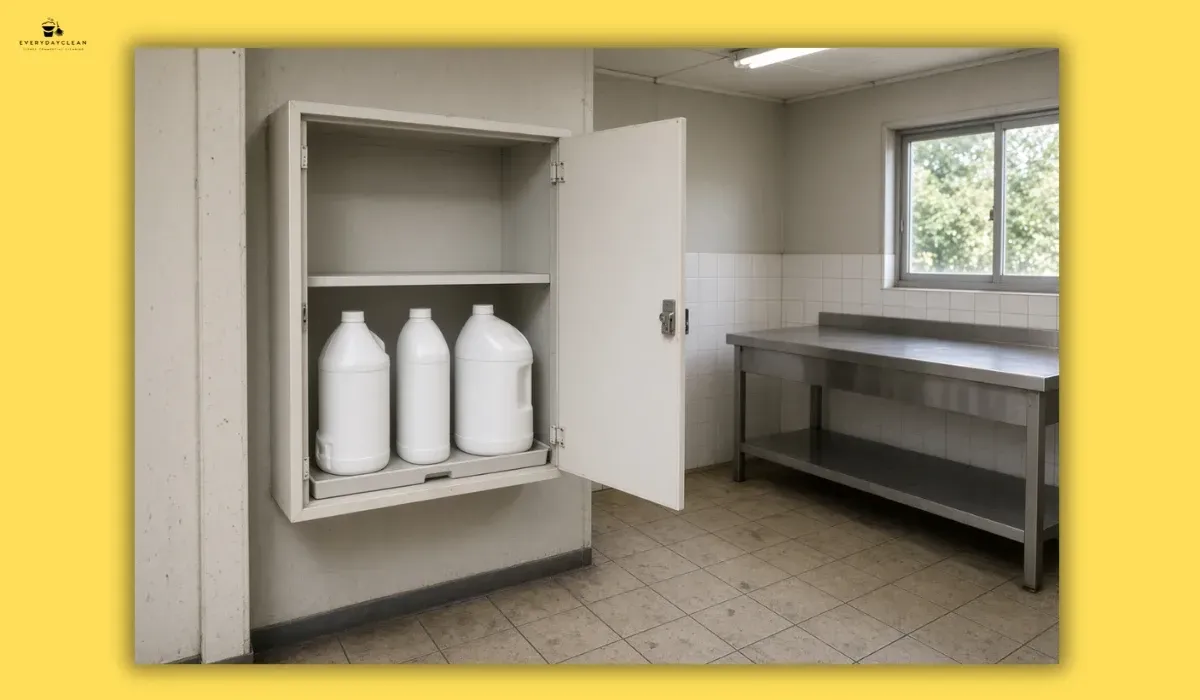
Specify whether the contractor supplies all consumables and equipment, or whether the owners' corporation provides specific products. In buildings with sensitive surfaces - polished concrete lobbies, stone lift interiors, coated pool decks - the contract should name approved cleaning chemicals and reference compliance with AS/NZS 2243.10 (Safety in Laboratories: Storage of Chemicals) where hazardous materials handling is relevant. Buildings with childcare facilities or medical tenancies may require chemical-free or low-VOC products to be contractually mandated.
5. Insurance and compliance requirements
Every strata cleaning contract should require the contractor to hold:
- Public liability insurance (minimum $10 million - $20 million for large complexes)
- Workers' compensation insurance covering all on-site staff
- A copy of the contractor's WHS management plan compliant with the Work Health and Safety Act 2011 (NSW)
Under the Strata Schemes Management Act 2015, the owners' corporation carries a duty to maintain common property to a safe standard. Engaging an uninsured or non-compliant contractor creates direct legal exposure for the committee.
6. Performance standards and KPIs
The contract should define what a completed task looks like, not just that it occurred. Measurable performance indicators remove subjectivity when assessing whether the cleaner has met their obligations. Examples include: "lift floors to be mopped daily to a visibly clean standard with no standing liquid or debris at time of inspection" or "bin room surfaces to be disinfected weekly using a hospital-grade disinfectant with a minimum 30-second dwell time."
A standardised inspection checklist - referenced in the contract and signed off at agreed intervals - creates a documented performance record that both parties can rely on.
7. Reporting and communication protocols
Define who the cleaner reports to, how service issues are escalated, and within what timeframe a remediation must occur after a performance failure is identified. Industry experience consistently shows that buildings with a written remediation window - such as 48 hours to address a missed task and 14 days to address a recurring issue - resolve complaints faster and with less committee time than those that handle performance concerns informally.
8. Pricing, invoicing, and variation terms
State the monthly or periodic fee, the billing cycle, and the conditions under which the price can be varied. Annual CPI adjustments tied to the Consumer Price Index are standard in multi-year strata contracts. Ad-hoc services - post-event cleaning, emergency spill response, flood remediation - should be priced separately in a schedule of rates rather than left open for ad-hoc negotiation each time.
9. Contract term, renewal, and termination
Specify the initial contract term, the process and notice period for renewal, and the grounds on which either party can terminate. Standard notice periods for strata cleaning contracts range from 30 to 90 days. Termination for cause - persistent underperformance, insurance lapse, failure to remediate - should require a shorter notice period than termination for convenience.
10. Dispute resolution pathway
Include a written escalation process: first to the strata manager, then to the owners' corporation committee, and if unresolved, to mediation or the NSW Civil and Administrative Tribunal (NCAT) under the relevant provisions of the Strata Schemes Management Act 2015. Having this pathway in writing reduces the likelihood of disputes escalating to a tribunal unnecessarily.

The 2025 NSW Law Change: Every Strata Contract Must Reflect
From 1 July 2025, standard-form strata cleaning contracts entered into, renewed, or varied in NSW are subject to the unfair contract terms provisions of the Australian Consumer Law (ACL), as extended by the Strata Schemes Legislation Amendment Act 2025.
This is a material change that affects every owners' corporation reviewing or renewing a cleaning contract. Prior to this reform, owners' corporations fell outside the ACL's consumer definition and had limited recourse against one-sided contract terms.
Under the new rules, a term is considered unfair if it creates a significant imbalance in the parties' rights and obligations, is not reasonably necessary to protect the legitimate interests of the party who benefits from it, and would cause detriment to the owners' corporation if applied. Specific terms now banned under the Act include:
- Automatic renewals that lock the scheme into ongoing agreements without a review trigger
- Excessive early-termination penalties that apply only to the owners corporation
- Liability cap clauses that limit the contractor's exposure regardless of the nature or scale of a service failure
Any strata cleaning contract renewed or varied on or after 1 July 2025 must be audited against these provisions before signing. Legal advice is recommended for any contract containing liability limitation language or one-sided termination rights.
How to Compare Strata Cleaning Quotes Properly
Price comparison between competing strata cleaning quotes is only meaningful when the scopes being quoted are identical. A lower quote built on a narrower scope - excluding bin rooms, quarterly deep cleans, or post-event response - is not a saving. It is a deferred cost that surfaces as a variation request six months into the contract.
Before requesting quotes, the owners' corporation or strata manager should issue a written cleaning specification that defines every area, task, frequency, and performance standard required. This is called a scope of work or a request for proposal (RFP). Contractors quoting against the same specification produce comparable proposals that can be evaluated on price, service quality, insurance coverage, and reporting capability simultaneously.
When evaluating quotes, the five criteria that predict long-term contract performance are:
- Insurance coverage and the limits stated on the certificate of currency
- Staff training documentation, and whether the cleaner holds a current police check
- Quality assurance systems - specifically, whether the contractor uses a documented inspection checklist
- Chemical safety compliance, particularly for buildings with sensitive occupants or surfaces
- References from comparable strata buildings of similar size and complexity
The market rate for strata cleaning contracts varies significantly by building size and service frequency. A standard low-rise residential strata building in a metropolitan area typically contracts for $1,800 to $3,500 per month. Large mixed-use buildings with daily cleaning requirements, gym facilities, pool decks, and parking structures can reach $5,500 per month or above. These figures reflect professional contractor rates inclusive of equipment, consumables, supervision, and insurance - not independently sourced labour at award rates.
Ongoing Contract Management After Signing
Signing a strata cleaning contract does not end the owners' corporation's obligation. The Strata Schemes Management Act 2015 requires the owners corporation to maintain common property to the standard agreed in the building's by-laws. If cleaning quality falls below that standard, the responsibility does not transfer entirely to the contractor - the owners' corporation must demonstrate it monitored and enforced the contract.
Practical contract management involves three levels of oversight. First, a site sign-off log that the cleaner completes after each visit, recording the date, time, tasks completed, and areas attended. Second, a monthly or fortnightly supervisor inspection using a standardised checklist tied directly to the contract scope. Third, a quarterly review meeting between the strata manager and the cleaning contractor to assess performance trends, plan seasonal cleaning requirements, and address any emerging issues before they generate resident complaints.
Digital reporting platforms used by professional strata cleaning companies provide committee members and strata managers with real-time access to visit logs, inspection photographs, and performance data. This transparency reduces disputes by providing objective evidence that tasks were completed - or that they were not.
Specialist services that fall outside the standard maintenance scope - window cleaning, high-reach facade work, carpet deep cleans, and post-event response - should be documented as separate line items or supplementary agreements rather than absorbed into the base contract rate. Everyday Clean's strata cleaning contracts are structured this way by default, with specialist works priced in a separate schedule of rates so the committee can activate them without a new tender process.

FAQs about The Strata Cleaning Contracts
Strata committee members, lot owners, and strata managers consistently ask a similar set of questions when reviewing or tendering a strata cleaning contract. The answers below address the queries that appear most frequently across strata forums, industry bodies, and service comparison platforms.
What should be included in a strata cleaning contract?
A strata cleaning contract must include: the full legal names of both parties (owners corporation and contractor); a defined scope of common property areas with individual task and frequency specifications; insurance requirements (minimum $10 million public liability and workers compensation); performance standards against which each task is measured; a documented inspection and sign-off process; pricing, invoicing terms, and CPI variation conditions; the contract term, renewal process, and termination notice periods; and a written dispute resolution pathway. Contracts that omit scope definitions or performance standards create the conditions for persistent disputes that no amount of goodwill can resolve efficiently.
How long should a strata cleaning contract be?
Most strata cleaning contracts run for 12 to 24 months with a renewal option. Longer initial terms - three years or more - are appropriate for large buildings where the contractor has invested in specialised equipment or dedicated staff for the site. Under the Strata Schemes Legislation Amendment Act 2025, contracts renewed in NSW on or after 1 July 2025 must not contain automatic renewal clauses that lock the owners corporation in without a review trigger. A 30 to 90 day notice period for non-renewal is standard. Shorter terms suit smaller buildings or first engagements with a new contractor where the committee wants flexibility before committing to a longer arrangement.
Can a strata committee terminate a cleaning contract early?
Yes, subject to the termination terms written into the contract. Termination for cause - persistent failure to meet performance standards, insurance lapse, or conduct issues on site - typically allows a shorter notice period, sometimes as little as 14 days with documented evidence of the breach. Termination for convenience generally requires the full notice period (30 to 90 days) and may carry an early-termination fee if specified in the contract. Under the 2025 NSW reforms, excessive early-termination penalties that apply only to the owners corporation are classified as potentially unfair contract terms and may be void. Any committee considering early termination should review the contract's termination clause carefully before issuing notice.
Does a strata cleaning contract need to go to a general meeting?
Spending limits for contracts vary by strata scheme. Under the Strata Schemes Management Act 2015, the owners corporation committee can approve routine expenditure within budget without a general meeting. However, cleaning contracts that exceed the scheme's approved administrative fund budget, or that commit the owners corporation to spending above the threshold requiring a general meeting resolution, must go to a vote. The specific threshold depends on the scheme's by-laws and current budget. Strata managers typically advise committees on whether a proposed contract requires general meeting approval before the tender process concludes. Obtaining this advice before signing avoids the risk of an invalidated contract.
What insurance should a strata cleaning contractor hold?
Every strata cleaning contractor should hold current public liability insurance with a minimum limit of $10 million - and $20 million is standard for larger or more complex buildings. Workers compensation insurance must cover all staff who attend the site, including casual and subcontracted workers. The owners corporation should request a certificate of currency for both policies before the contract commences, and should build a requirement for annual insurance renewal evidence into the contract terms. Contractors who cannot produce current certificates at signing should not be engaged, regardless of price. Insurance gaps expose the owners corporation to liability for on-site incidents that should be the contractor's responsibility.
Getting a Strata Cleaning Contract Right the First Time
A strata cleaning contract that fails does so predictably - through a vague scope, an unverified insurance certificate, or a missing performance standard that left both parties guessing what "clean" actually meant. The buildings with the fewest cleaning disputes are not the ones with the cheapest contractors or the longest contracts. They are the ones where the committee invested time in the specification before going to market, and where the contract document was treated as a working management tool rather than a formality filed and forgotten after signing.
The 2025 NSW reforms under the Strata Schemes Legislation Amendment Act 2025 have raised the legal floor for what constitutes a fair and enforceable strata cleaning contract. Automatic renewals, one-sided liability caps, and penalty-only termination clauses are now subject to challenge under the Australian Consumer Law. For any strata committee reviewing or tendering a cleaning contract in 2026, this is not optional housekeeping - it is a legal compliance obligation.
A well-structured strata cleaning contract protects residents, distributes accountability fairly, and gives the committee a clear mechanism to act when standards slip. The ten elements covered in this article are not a checklist to collect signatures against. They are the foundations of a service relationship that keeps common property clean, compliant, and dispute-free for the full term of the agreement.
For buildings with office tenancies inside the strata complex, office cleaning Sydney services cover the internal workspace scope separately from common property obligations.
CBD-based strata and commercial buildings can access dedicated office cleaning Sydney CBD packages tailored to high-density access requirements.
Mixed-use and fully commercial strata properties are covered under Everyday Clean's
commercial cleaning services.
Blog